


Attack on Venezuela is a Threat to Latin America and Brazil: Brazilian Communists

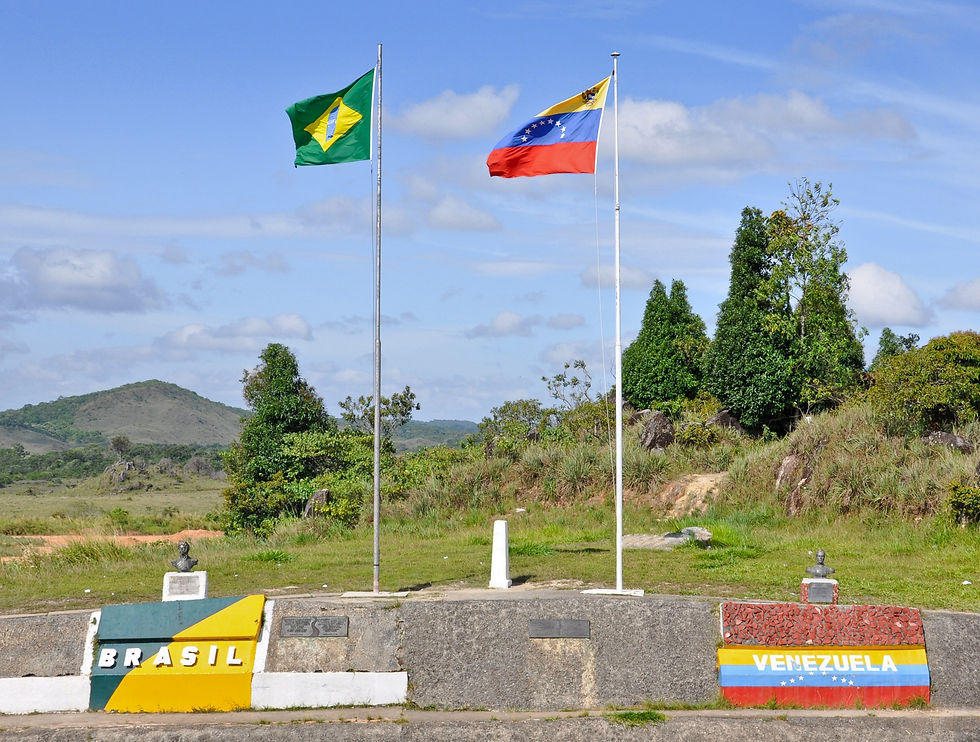
Paolostefano1412, CC BY-SA 3.0, via Wikimedia Commons
Resisting Imperialism with Popular Organization
Attack on Venezuela is a Threat to Latin America and Brazil
The Brazilian Communist Party (PCB) expresses its unwavering solidarity with the Venezuelan people in the face of the criminal imperialist attack carried out by the United States against the Bolivarian Republic of Venezuela and demands the freedom of President Nicolás Maduro and the first combatant Cília Flores, as well as their immediate return to their homeland. The PCB considers this attack an international crime and warns that actions against Venezuelan sovereignty represent a threat to all of Latin America and, especially, to Brazil, due to its vast mineral wealth and political weight in the region.
The aggression against Venezuela is neither an isolated event nor the result of conjunctural circumstances. It is the first practical and violent action of the new security doctrine formulated by the Trump administration, whose aim is to reestablish Latin America and the Caribbean as a direct zone of its strategic domination, unabashedly reviving the logic of the Monroe Doctrine. This new doctrine must be understood as a desperate response by U.S. imperialism to its systemic crisis, the decline of its global hegemony, and the emergence of new economic, technological, and military powers. Unable to sustain domination through consensus as in some past moments, the Trump administration now resorts only to sanctions, economic blackmail, and state terrorism.
The core of this doctrine is not limited to its content and imperialist objectives, such as control of natural resources, market domination, and political submission, but especially to the explicit, brutal, cynical, and criminal manner in which these objectives are now declared and executed. This fact strips away the masks and exposes the predatory character of imperialism in its phase of historical decline. By defining Latin America as a U.S. national security space, the Trump administration seeks to transform the region's strategic resources—oil, water, biodiversity, strategic minerals, and food—into assets to be appropriated and controlled by large U.S. capital.
The aggression against Venezuela also reveals the methods of the imperial offensive: direct use of military power, intelligence community operations to map resources and businesses, economic sanctions, political sabotage, encouragement of coups d'état, interference in elections, and, when necessary, armed invasion. As the doctrine itself emphasizes, countries that submit to Washington's dictates will be rewarded with economic favors and political support, while those that resist will be exemplarily punished. This is a system of coercion aimed at fragmenting the region, destroying integration processes, and preventing any autonomous development project, even those of a reformist nature.
This strategy also represents a direct threat to social and popular movements. The doctrine defines social, migratory, and environmental movements as threats to the imperial order, laying the groundwork for the criminalization of popular resistance, which would henceforth be treated as a security issue. This opens the door for intensified repression against workers and popular movements, the suppression of democratic freedoms, and the strengthening of authoritarian governments.
Brazil and the New Doctrine
In this new conjuncture, Brazil becomes, against its own will, the center of a geopolitical dispute between the United States, China, and Russia. This is because the country occupies a strategic position in the imperial redesign of the region, meeting at least four decisive material and political conditions that are targets of imperialist greed:
a) Brazil is one of the few industrialized countries on the continent, one of the ten largest economies in the world, with a relevant financial system, a large internal market—the largest in South America—and significant political weight among Latin American and Global South countries, despite having a rather fragile military structure.
b) Due to its continental dimensions, the country possesses strategic natural resources such as lithium, niobium, oil, among others, as well as abundant freshwater, vast arable lands, and 21% of the world's rare earth minerals, the most coveted minerals by U.S. imperialism.
c) It promotes regional integration alliances such as Mercosur, UNASUR, and CELAC, and internationally with BRICS, while also being China's largest trading partner. It also maintains good relations with Russia and possesses political and diplomatic articulation capacity.
d) It is a major producer of food and energy and has one of the world's largest reserves of biodiversity.
According to the new doctrine, U.S. imperialism considers it unacceptable for a nation to have these economic, political, and material conditions outside its domain, especially because it is a country with the potential to build economic alternatives outside Washington's interests and has special relations with the main declared enemies of the United States. Under these circumstances, the Trump doctrine leaves no doubt: each country in the region must choose a side in this dispute. Those who accept subordination will be rewarded, and those who do not fit into the new strategy will suffer the consequences of imperial power.
Therefore, Brazil is not immune to the imperialist offensive, and it would be a grave historical error to maintain any illusions in this regard. Even under a moderate government like Lula's and despite Trump and Lula declaring themselves "chemically close," Brazil is already being targeted for prospecting of its natural resources and surveillance by the U.S. intelligence community. It must not be forgotten that, even in times different from the present, the country suffered surveillance, destabilization attempts, lawfare actions like Operation Car Wash, and the coup against Dilma Rousseff, demonstrating that imperialism has no friends, only interests.
It must also be recognized that imperialism has a large internal social and political base in Brazil. Bolsonarism is the most open ally of the Trump administration in the country, currently leading several state and municipal governments, with a strong presence in the Chamber of Deputies and the Senate, as well as in Legislative Assemblies and municipal councils. It also wields significant influence among Pentecostal churches, urban middle-class sectors, the Armed Forces, and even the proletariat. Additionally, the associated bourgeoisie, agribusiness sectors, and corporate media act as transmission belts for imperialist interests within the Brazilian state.
For Brazil, this new conjuncture represents a structural threat to our fragile national and popular sovereignty, the possibility of autonomous development and reindustrialization, regional integration, and articulation with BRICS. It is especially a threat to social and popular movements. U.S. imperialist policy leaves no room for neutrality or conciliatory illusions. This is an aggressive escalation that directly threatens the existence of the country as a sovereign nation. Faced with this historical crossroads, the PCB asserts that resisting Trump's attacks is not an abstract ideological choice but a political and existential necessity. Accepting subordination means condemning the country to backwardness, submission, and social barbarism.
Faced with this complex and dangerous conjuncture, the PCB advocates for the urgent construction of a broad Anti-Imperialist Front in Brazil, capable of articulating workers, youth, trade union and popular movements, democratic forces, and sectors in contradiction with U.S. imperialism. This front must materialize in a great effort to create Popular Anti-Imperialist Committees alongside social and popular organizations, in territories and workplaces, with the perspective of transforming resistance into a mass movement capable of confronting the empire in our country. It must also place on the agenda the need for structural reforms, with the strategic perspective of building a Socialist Brazil.
No resistance can become victorious if it does not serve the interests of the working class and the great poor masses of our country and formulate an alternative that breaks with the elite pact, neoliberalism, the reprimarization of the economy, and institutionalized rent-seeking, while ensuring rights and guarantees for the working people. It is necessary to confront structural inequality, placing the country's natural resources at the service of social development aimed at building a new direction for Brazil from the perspective of popular interests—that is, the establishment of a proletarian state, the only guarantee for a truly sovereign country free from imperial exploitation.
This is the historical task before us. The PCB and its militants commit to rising to this challenge by organizing, raising awareness, and mobilizing workers and youth so that popular resistance becomes a force capable of opening a new path for Brazil and the peoples of Latin America.
Out with Imperialism from Latin America!
For the Liberation of Maduro and First Combatant Cília Flores!
Full Support to the Struggle of the Venezuelan Working Class!
For Popular Power on the Path to Socialism!
For a Sovereign and Socialist Latin America!
Central Committee of the PCB


Comments