


Birthday of Paulo Freire, Educator of the World

w. Freire's epic poem Recife Forever
By Urariano Mota
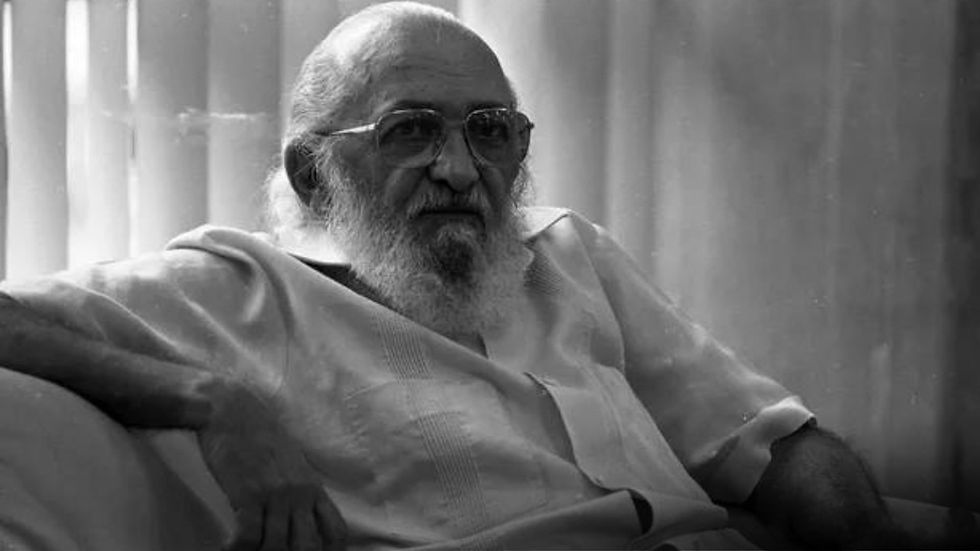
Born in Recife on September 19, 1921, Paulo Freire overcame the contradiction of being from Recife and simultaneously a citizen of the world-at-large. Far from Pernambuco, he reinvented himself as a man without borders by the strength of his work as a revolutionary philosopher and teacher only to suffer a second, posthumous exile in the Bolsonaro regime. Once considered the “Patron of Brazilian Education,” he has again become a refugee, a scourge, a dirty word in the new dictatorship even though he is the Brazilian who has received the most honorary doctorates from worldwide universities. Perhaps this is the reason he suffers from the bile of a fascist government that hates teachers and education?
It is worth remembering the brief history of his 1964 imprisonment in the Brazilian Army barracks in Olinda. He was asked by one of the officers in charge of the grenade-launchers who bunked there, a man who was aware of his reputation, if he would teach some of the raw recruits who could only sign their names with an X the rudiments of literacy. Paulo denied the request with a wan smile, “I am imprisoned here now because of that work.”
Because he is so admired outside of Brazil, Paulo Freire is sometimes revered for the wrong reasons. Those who read and study him cannot escape the nature of his real ideology. According to Eeva Anttila, a professor at the University of the Arts in Helsinki, Finland, “his ideas have been used for political ends. It is my understanding that this was never his initial purpose.” However, we know that the bonds between politics and liberty are indissoluble in his work.
In Education for Critical Consciousness, written in Chile in 1965 but first published in English in 1973, Freire writes: “In the experiments carried out in the [Brazilian state of] Rio Grande do Norte, the students called the terms that made sense to them “thinking words” and those that did not “dead words.” In one of the Culture Circles in Angicos [a small town in that state’s interior] on the fifth day of our dialogue when we were still working on simple phonemes, one of the participants went to the blackboard with what he called a “thinking word” and wrote ‘the peepul ficks the problums of Brasil by voting dair conshus.’ When a student from Angicos made a speech in front of President [João] Goulart on graduation day, he declared the word povo (people) was different from the word massa (a mass of people), he was aware that this was an option. He chose participation, as the people must, and renounced the hegemon’s traditional dismissal of the masses. He understood that education is by nature political.”
In Pedagogy of the Oppressed, written in 1968 [first published in English in 1970], the third most cited book in the world in the area of humanities, Paulo Freire’s thoughts about education deepen:
“In order for the oppressed to be able to wage the struggle for their liberation, they must perceive the reality of oppression not as a closed world from which there is no exit, but as a limiting situation which they can transform. This perception is a necessary but not a sufficient condition for liberation: it must become the motivating force for liberating action. Nor does the discovery by the oppressed that they exist in dialectical relationship to the oppressor, as his antithesis—that without them the oppressor could not exist—in itself constitute liberation. The oppressed can overcome the contradiction in which they are caught only when this perception enlists them in the struggle to free themselves.”
In other parts of the book, Freire refers to his dialogue with Marxism:
“[The] world and human beings do not exist apart from each other, they constantly interact. Marx does not espouse such a dichotomy, nor does any other realistic critical thinker. What Marx criticized and scientifically destroyed was not subjectivity, but subjectivism and psychologism…Problem-posing education does not and cannot serve the interests of the oppressor. No oppressive order would permit the oppressed to ask ‘Why?’ Only a revolutionary society can carry out this education in systematic terms. The revolutionary leaders need not take full power before they can employ this kind of education. In the revolutionary process, the leaders cannot utilize the banking method as an interim measure, justified on grounds of expediency, with the intention of later behaving in a genuinely revolutionary fashion. They must be revolutionary and dialogical from the outset.”
These citations make it clear that Paulo Freire’s pedagogy was of a leftist, progressive bent and unfailingly political. However, it was clearly not that of an orthodox or organized Marxist. Freire differed from the sectarianism of the party in 1960s Recife but always preserved brotherly dialogue with his future comrades. When we absorb his writing, we are struck by its cultural and philosophical amplitude, nourished by Marxist and non-Marxist classics, like Bergson, which remind us he is drinking from springs both national and foreign. The concepts that Paulo Freire discovers are those of a researcher and a thinker. I do not know which comes first, his experience in the streets and in the field or his thinking about what he has seen there. In terms of his development, both his work in the midst of the people and later reflection on this work are viable. What is clear is that both strains lead to what he calls praxis.
“Praxis is the reflection and action of people on the world in order to transform it. Without it, overcoming the oppressor-oppressed contradiction is impossible.
“Per se, reality bends toward domestication. To free oneself from this power demands one emerge from it and having shaken it off returns, again, to deal with its habitual effects. That is why it can only be done through authentic praxis and not by way of ‘blah blah blah’ or activism. You can only do it through concerted action and reflection.”
Praxis is alive. It is not just a rhetorical objective. It lives in Freire’s words:
“Only in the fullness of this act of love, in its existentialism, in its praxis, does it become true solidarity.” And here we come to a crucial point of Paulo Freire’s person: he was someone who loved deeply. His was a special kind of love, a tender affection toward people, animals and trees that stemmed from his childhood and youth in Recife. In a lovely way, this amorous praxis shines clearly through a long poem he wrote in his initial exile in Santiago de Chile. The person who made me aware of this beautiful poem was Peter Lownds, a very Brazilian North American writer and poet who is also a Freirian scholar. I don’t know whether to cite an excerpt or the whole poem. But who am I to edit Paulo Freire’s poetry? Let’s put the whole thing down here, this hymn to the people that our greatest educator wrote thousands of miles from home, while experiencing the most intense saudade.
Urariano Mota’s article translated from the Portuguese by Peter Lownds, September 19th, 2021 in honor of Paulo Freire’s centennial
Urariano Mota is a Brazilian writer and journalist, born in Recife on September 29, 1950. He is the author of novels about the horrors of the Brazilian dictatorship, such as “Soledad no Recife” and “Never-Ending Youth”
RECIFE FOREVER*
From Santiago I write you, Recife
to speak of you to you
to tell you I love you
deeply, I love you.
It’s been five years since I left you—
early morning—I was afraid to look at you
afraid to wound you
afraid to embitter you.
Early morning—I didn’t say a word
What to say if you’re parting?
I was afraid to hear myself
afraid to look at myself
afraid to wound myself.
Early morning—crossing the streets
the airport drawing near
the moment of departure also
a thousand memories of you
crowding my enforced silence.
From Santiago I write you
to speak of you to you
to tell you of my saudade, Recife
Gentle longing—patient longing
well-behaved longing.
Recife, forever Recife,
of streets with such sweet names,
Union Street, which Manuel Bandeira
was afraid would be called
“Somebody or other street”
and which, today, I fear
will soon be called
“Colonel Somebody” street.
Street of the creole girls
Street of the dawn
Street of friendship
Street of the Seven Sins.
Recife forever.
Your men of the people
burnt umber by the sun
rhythmically shouting in the streets:
“Cry baby so mama buys you pitomba fruit!”
“I have a fat sheep’s wool for your pillows!”
“Sweet banana and guava paste!”
It seems so long ago!
For us, boys from the same street,
That man who walked so fast
almost running, shouting, shouting:
“Sweet banana and guava paste!”
At each corner, one of us would say:
“I want banana, sweet banana paste!”
Already smiling at the response to come.
Without stopping
without looking back
without looking to the side
walking fast, almost running
the mechanical man answered us:
“I only have guava—I cry
‘banana’ only from habit:
“Sweet banana and guava paste!
Sweet banana and guava paste!”
He continued to shout,
walking almost running
without looking back
without looking to the side
our mechanical man.
It was necessary for time to pass
much rain needed to fall
many suns had to set
many tides had to turn from high to low
lots of children needed to be born
many people had to die
many days needed to break
many trees had to bud and flower
many Marias had to fall in love
many fields to become dry
a lot of pain had to exist
I had to look into many sad eyes
in order to understand that
the man we treated like a toy
was my brother,
my downcast brother
my exploited brother
my offended brother
my brother oppressed,
prohibited from being.
Recife, where I was hungry
where I felt pain
without knowing why
where still today
so many, so terribly many
have the same hunger
without knowing why
have the same pain,
I cannot be angry at you.
Recife, where late one day
I was hungry
without knowing why
where still today
so many, so terribly many
have the same hunger
without knowing why
have the same pain,
I cannot be angry at you.
Recife, where late one day
I was hungry and knew not why
I thought so much
about those who were not eating
about those who had no clothes
about those who did not smile
about those who did not know
what to do with their lives.
I thought so much
about the disinherited ones
about the mistreated ones
about those who stood at the gate
but did not enter
about those who entered
but did not remain
about those who remained
but could not be
about the children
who were already working
before they were born
while still in the womb
helping their mothers
beg for alms and
receiving crumbs and
cold-hearted stares.
Recife, I am not angry at you.
I came to know your jails as a grown man.
One two three four
four three two one
forward and back again
whistles—lock step
soldier, do not think!
one two three four
four three two one
right left
halt! left right
soldier, do not think!
what I wanted
what I want,
what I will always want
is that people—all people
may eat
may have clothes
may wear shoes
may have children
and that the children
will not go hungry
will not be in pain
may play
may smile
may sing
may love
and may be loved.
Recife, city of mine
already a grown man
I came to know your jails.
In them I was an object
I was a thing
I was an oddity
Wednesday—four in the afternoon
the iron gate opened.
“Today is visitors’ day. Line up!
I’ll punish anyone who tries
To sneak in a single chocolate
I’ll search all of you.”
So said one of our ‘bosses’
In a harsh voice
A man smaller than his post
Then we marched awkwardly,
without cadence, toward our wounded wives
our afflicted mothers
our startled children.
In those meetings I discovered something new:
In front of Elza, my wife
and the Three Marias,
our daughters
I had many words to say
many things to ask
much hope to express
but a lot of hunger to subdue as well
and thirty minutes to eat and communicate.
In those meetings I discovered something:
words and food collide.
Recife, city of mine,
as a grown man,
I came to know your jails.
“Captain, when this doctor writes Creator,
meaning God, he writes it with a small c!
Creator with a big C is mine alone.”
The coronel, who owned the world
who owned the prisoners,
wanted to own God as well.
Wealthy coronel that one!
Poor man that one!
He wanted to make God a jailor
or his flunkey
or his spy
to help him hunt subversives.
Recife, city of mine,
As a grown man I came to know your jails.
I dealt with silence
and solitary confinement.
I spent hours in a kind of box—
five feet six inches high
twenty-three inches wide.
Cold walls
rough walls
darkness.
I lived peacefully, I slept peacefully,
I regretted nothing
Recife, city of mine,
As a grown man I came to know your jails.
One two three four
four three two one
the men learning not to be men.
The clock in my house also tolled
one two three four
four three two one
but it sang a different song.
Singing this way
it only marked men’s days.
Recife, city of mine,
in you I lived a sad childhood
bitter adolescence I lived in you.
They cannot understand me if they do not understand you:
my greediness for love
my hope in the struggle
my confidence in the oppressed
all this was forged in me,
through my relations with you:
in the sad childhood,
in the bitter adolescence.
What I do
what I think
what I say
what I write,
everything bears your mark.
I am still the boy who was hungry,
who was in terrible pain
without knowing why.
Only one difference exists
between the boy of yesterday
and the boy of today,
who still lives within:
now I know why I was hungry
now I know why I was in pain.
Recife, city of mine, I say it out loud:
if someone loves me
they also love you.
If someone wants me
they must want you.
If someone looks for me
let them find me in you:
in your nights,
in your days
in your streets
in your rivers
in your sea
in your sun
in your people
in your heat
in your ravines
in your restlessness
in your silence
in the lovingness of those who fought
and who fight still
of those who exposed themselves
and who expose themselves still
of those who died
and who die still
while seeking, with increasing fervor,
that fewer children
will feel hunger and pain
without knowing why.
That is why I say:
they cannot understand me
if they do not understand you—
what I do
what I think
what I say
what I write
everything bears your mark.
Recife, city of mine,
from Santiago I write you
to tell you that I love you
deeply, that I love you.
*written by Paulo Freire, Santiago de Chile, February 1969
Translated from the Portuguese by Peter Lownds, Los Angeles, January 1999
Revised September 19, 2021 in commemoration of Paulo Freire’s hundredth anniversary.



Comments