


Brazil's Landless Workers' Movement honoured in Havana


Images via Estudios Revolución
By René Tamayo León, translated from the Spanish
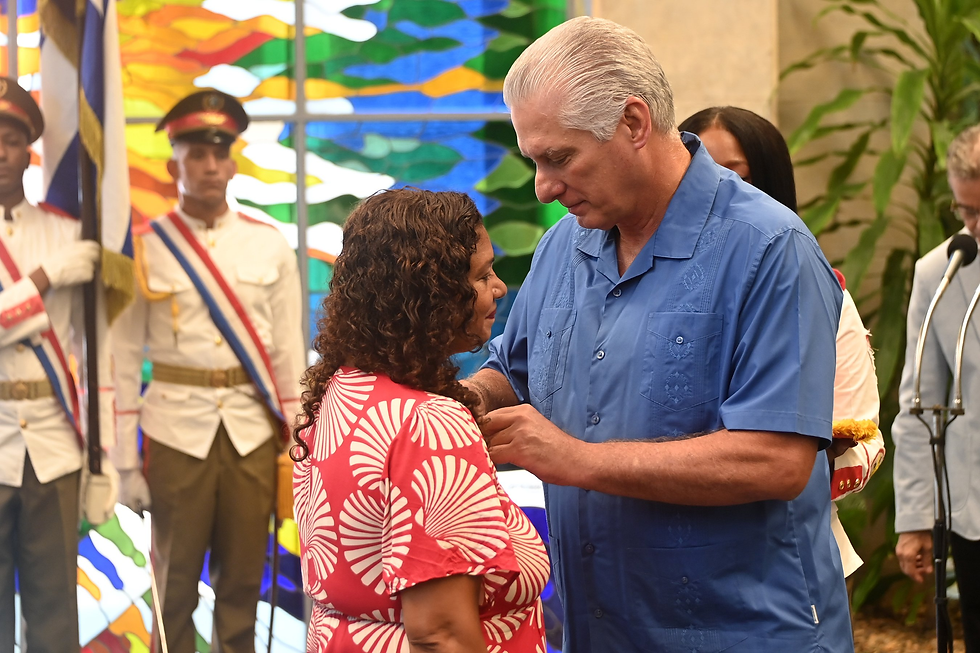
In a modest ceremony honoring genuine friendship, rooted in shared struggles and aspirations, Miguel Díaz-Canel Bermúdez, the First Secretary of the Central Committee of the Communist Party of Cuba and President of the Republic, awarded the Medal of Friendship to two distinguished members of Brazil's Landless Workers' Movement (MST), comrades Nivia Regina Da Silva and Marcelo Durao.
On Wednesday morning, in the stunning El Sol de América hall at the Palace of the Revolution, a medal presentation was held that honors solidarity and is bestowed by the Council of State of the Republic of Cuba. This event also paid tribute to the struggle of an entire nation.
During the awarding of the Medal of Friendship to the comrades of the MST, a proposal made by the Cuban Institute of Friendship with the Peoples (ICAP), it was emphasized that the Landless Movement has demonstrated that an alternative world is possible, that land should belong to those who work it, that food sovereignty is a fundamental right, and that international solidarity is the path to attain it.
The MST is a movement that for more than four decades has been an unstoppable force in the struggle for social justice, agrarian reform and the sovereignty of the peoples and its actions and militant solidarity with the Cuban Revolution and its people is unconditional and has been present since its very foundation.

The tribute brought together comrades Emilio Lozada García, head of the Department of International Relations of the Party’s Central Committee, and Deputy Prime Minister Jorge Luis Tapia Fonseca, along with other leaders from the Party, State, Government, mass organizations, and institutions. Also present were Christian Vargas, Brazil’s ambassador to Cuba, and Marcelo Resende, the FAO representative in the country.
NIVIA AND MARCELO: SOLIDARITY WITH CUBA
"Today we not only bestow two medals; today we embrace two comrades, two fighters who have made solidarity with Cuba a focus of their lives," said comrade Fernando González Llort, president of ICAP, when explaining the decision to grant this high distinction to the outstanding social activists Nivia Regina Da Silva and Marcelo Durao.
He spoke fondly of comrade Nivia, noting that she’s an agronomist specializing in agroecology with a master’s degree in agrosystems, a leader in the production and cooperation sector, and a member of both the National Bureau and the National Coordination of the MST.

A woman, he added, "who has shown how to put science at the service of life, and militancy at the service of those who have less," who has been on the front lines of solidarity with Cuba, joining protests against the blockade outside the U.S. embassy in Brasília and the consulate in Rio de Janeiro, leading signature campaigns, and calling for the freedom of the Five. All of this shows that she is “a woman who doesn’t just talk, but acts, fights, and sows.”
De Marcelo recalled that she was part of the state leadership of the movement in Rio de Janeiro, served on the National Directorate, and is now a member of the National Coordination. Beyond her roles, she has been a steadfast friend of Cuba.
"Marcelo," he said, "participated in the construction of the CLOC Via Campesina, of ALBA Movements, in the campaigns against the FTAA, and when the freedom of the Five was a cause that many were silent about, she took the pencils and drawings of the children of the MST and turned them into letters, into cries, into hope."
During the Solidarity Medal presentation, the discussion also covered Marcelo and Nivia's involvement in recent years in distributing donations of dozens of tons of grain seeds, vegetables, agricultural machinery, and medicines for Cuban hospitals.

FRIENDSHIP AND CONTINUITY
Grateful for receiving the Medal of Friendship, comrade Nivia, echoing Marcelo’s sentiments, emphasized that it was “a collective achievement” shared by peasants and militants alike. “This medal represents the collective spirit of the MST,” she remarked.
Receiving it, he explained, "is to seal the continuity of our commitment, our loyalty and our trust with Cuba." We, she added, are the fruits of this historical relationship between Cuba and the MST, "which was always based on solidarity and internationalism."
Born in the final years of the military dictatorship and officially established in 1984, this peasant movement has centered its efforts on agrarian reform, occupying idle lands, and driving social change, always guided by agroecology and the defense of rural workers' rights.
Today, it brings together over half a million families settled and camped across 24 states in Brazil, earning international recognition for its organizational strength and dedication to popular education. It has built more than 2,000 public schools serving around 200,000 people and has already taught over 100,000 individuals to read and write. Its Florestan Fernández school is one of the most important centers of political training in our region.

This work was translated and shared via a License CC-BY-NC


Comments