


Digital Fascism, the Highest Stage of Capitalism

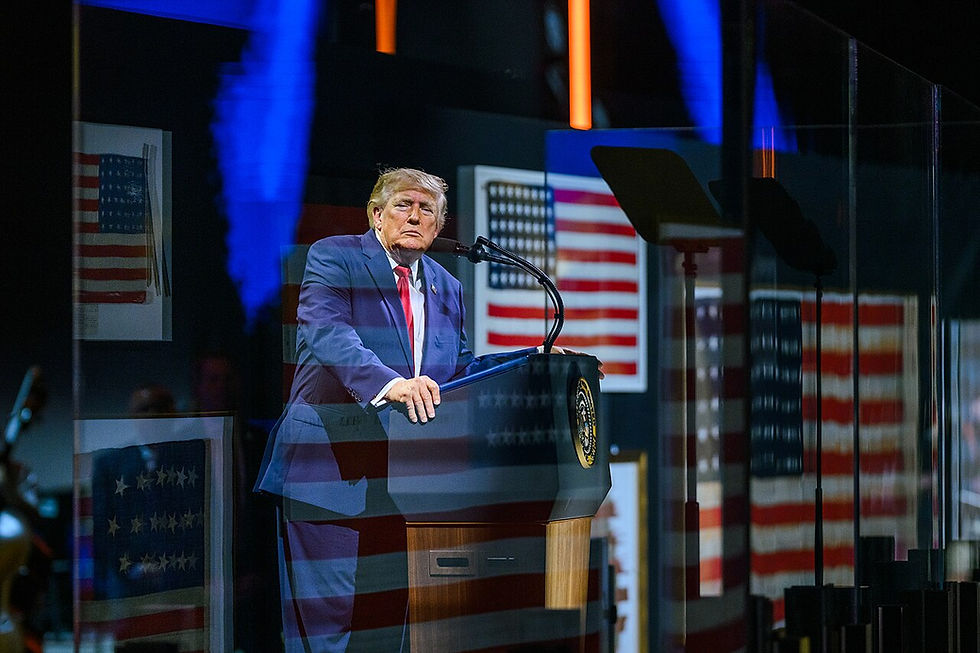
Trump on July 4, 2026 -- public domain image
By Rezgar Akrawi
When Vladimir Lenin wrote about imperialism and considered it the highest stage of capitalism, he was tracking the moment capital shifted from the space of free competition into the world of monopoly, where banks merged with industry, the state turned into a direct instrument serving finance capital, and the world was redivided by force among the great monopolistic blocs. Today, more than a century later, we stand before a transformation similar in essence, different in tools: digital fascism represents the stage in which monopoly capitalism moves beyond the boundaries of classical imperialism, invading the space of consciousness, behaviour, and data, through an organic merger between monopolistic technology capital and extreme nationalist political power. This merger finds its most vivid expression today in the Trumpist project, its alliances, and its aggressive wars.
Many well-known digital and technology companies known for their close relations with the Israeli military and the forced deportation systems in the United States, among them Palantir, constitute a revealing model of this stage. Yet the issue is broader than a single company. The core matter lies in the fact that monopolistic digital capital, having exhausted the possibilities of expansion through consumer markets alone, is today turning to weaponize its tools and employ them in an aggressive nationalist political project that reproduces the logic of colonial domination, this time backed by the language of algorithms.
From the Monopoly of Money to the Domination of Algorithms
In Lenin’s time, monopoly rested on control over the means of industrial production and financial markets. Today, control over the digital infrastructure itself is added to that: algorithms, databases, targeting systems, and communication platforms. This new monopoly is no less central than its financial predecessor, and in fact surpasses it in its ability to infiltrate the finest details of daily life. Every user, male and female, today turns into digital serfs inside systems they do not own, and over which they hold no real capacity to exert influence.
Unlike the classical financial monopoly that Lenin analysed, digital monopoly does not settle for silent economic exploitation. It moves rapidly into a stage in which the major monopolistic companies declare their ideological and political project with growing frankness, abandoning the mask of technical neutrality behind which they long hid. Philosophical and political statements issued by the leaderships of these companies frame investment in tools of targeting and surveillance as a moral duty toward the nation and civilization and portray refusal to participate in this project as failure or negligence.
Digital Fascism: The Alliance of Silicon Valley with the Aggressive Nation State
This alliance finds its clearest translation in the second Trump administration. The technological accelerationism movement, with its influential figures in Silicon Valley, supplies this administration with the digital tools to turn its aggressive nationalist rhetoric into actual control, domestically through the forced deportation of migrants, and externally through targeting systems that support military campaigns. Venezuela stands as a revealing model of this dimension, since Washington has, since mid 2025, relied on advanced digital surveillance and intelligence systems to track movements and identify targets, which led to air and naval strikes and a wide ranging military operation in early January 2026 that ended with the crime of abducting the Venezuelan president, in a flagrant violation of international law. Nor is this aggression separate from the brutal blockade imposed on Cuba for more than six decades.
As for the partnership between Washington and Tel Aviv, it is a deep technical partnership that provides Israel with data and targeting systems powered by artificial intelligence, which makes America and the major digital companies actual partners in documented war crimes against Palestinian civilians, while Trump works to deepen this alliance through massive security and military contracts that grant these companies growing influence in shaping policy.
Unlike traditional fascism, which needed a visible police state and a loud propaganda discourse, killing today does not need a responsible human decision or a declaration of war, instead, it needs an algorithm, data, and a green light from a device subject to no accountability whatsoever. The crime begins with classification, not with the bomb, and when entire communities are described as a threat through silent digital criteria, the killing of civilians turns into mere “security management” rather than genocidal crimes requiring accountability, in a logic that reproduces classical colonialism in the language of big data.
Yet the gravest danger lies in the surveillance society, where control becomes internal more than external. When an individual knows that they are constantly watched, they restrict themselves and move away from opposing ideas, and this voluntary self-surveillance restrains leftist and labour movements from within without the need for arrests, becoming the most efficient form of ideological domination, and the hardest to resist, because it penetrates the fabric of daily life and reshapes it from within.
The Alternative: Collective Ownership and Digital Socialism
Linking imperialism to digital fascism is not a theoretical metaphor, rather, it is an analytical necessity for understanding that the tools of domination have evolved, while their class essence has remained constant. The struggle today does not revolve only around how technology is used, rather, around who owns it, who determines its goals, and in favour of which social class it is employed.
Technology will not turn into a tool of liberation as long as it remains under the control of digital monopolies allied with the projects of the extreme right, wars, and repression. Therefore, any serious discussion about the future of technology must proceed from the necessity of building a digital socialist alternative resting on collective and communal ownership of digital infrastructure, and subjecting algorithms and artificial intelligence to genuine mass democratic oversight, through local and global legislation that expresses the interests of the working masses and the communities harmed by digital domination.
The struggle for social justice today inevitably passes through the struggle to liberate technology from this rightist, racist, and aggressive class alliance. Just as Lenin diagnosed imperialism as the highest stage of capitalism in his era, we can say today that digital fascism represents the highest stage in the development of that same imperialism, where technological digital monopoly capital merges with the extreme nationalist project into one organic alliance, whose goal is to concentrate power, wealth, consciousness, and human destiny in the hands of a small minority of the wealthy and the politicians.
To confront this reality, criticism and analysis are not enough, instead, we must move toward building joint internationalist work through digital leftist internationals capable of waging the struggle in the technological space and on the ground. This will be the subject of our next article.
Rezgar Akrawi is a leftist writer and researcher focused on technology, AI, the digital revolution, and the development of contemporary leftist thought and practice in response to these transformations. He works as an expert in systems development and e-governance and is a theorist of the concept of the ‘Electronic Left’.
This article was produced by Globetrotter.


Comments