


Images of Soviet Gorky, 1970


Here we are looking at images of the Soviet city of Gorky in 1970. These are from a postcard packet aimed at Soviet citizens as Gorky was not open to tourists.
Originally founded in 1221, the city of Nizhny Novgorod became an important trade and cultural hub in Russia. In 1932, during the Soviet era, it was renamed Gorky in honor of Maxim Gorky the great socialist realist writer and revolutionary.
Gorky was a major industrial and cultural center with a population of around 1,170,000 in 1970. It was home to the incredibly important Gorky Automobile Plant (GAZ), producing cars, trucks, and military vehicles.
It was also home to factories producing engines, industrial machinery, and defense equipment as well as scientific and research institutions focused on physics, engineering, and military technology, contributing to the USSR’s strategic industries.
Sadly, after the counterrevolution the city reverted to its pre-revolutionary name.
You can learn more about Maxim Gorky at: Maxim Gorky b. March 28, 1868

Maxim Gorky Statue

Railway Station

Gorky Palace of Labour

Monument to the Heroes and Martyrs of the 1905 Revolution

House of Communications

Kashirin House (Maxim Gorky Childhood Museum)
Monument to Valery Pavlovich Chkalov
Valery Pavlovich Chkalov (1904–1938) was a pioneering Soviet test pilot and long-distance aviator, best known for his record-setting transpolar flight from Moscow to Vancouver, Washington, and his contributions to Soviet aviation.
Chkalov was born on February 2, 1904, in the village of Vasilevo (later renamed Chkalovsk in hios honour), located near Gorky. His father was a ship boiler-maker, and his mother died when he was six years old. As a youth, Chkalov worked as a stoker on riverboats and in a shipyard, acquiring early mechanical skills. He first encountered an airplane in 1919, which inspired him to pursue aviation. At age 16, he joined the Red Army as an apprentice mechanic and later trained as a pilot, graduating in 1924 to serve in fighter squadrons.
Chkalov became a test pilot in the early 1930s, excelling in aerobatics and demonstrating extraordinary skill and daring in public displays. He tested over 70 aircraft types, including early Polikarpov fighters, and was instrumental in refining prototypes such as the I-15 biplane and the revolutionary I-16 monoplane. His record-setting aerobatic feats included performing 250 loop-the-loops in 45 minutes.
Chkalov achieved international fame in the 1930s through several long-distance flights. In 1936, he and his crew flew non-stop from Moscow to Kamchatka, covering 9,374 kilometers in 56 hours, setting a world record. His most notable accomplishment was the 1937 first non-stop transpolar flight from Moscow to Vancouver, Washington, spanning 63 hours and 9,130 kilometers via the North Pole, demonstrating the potential of polar air routes for long-range aviation. This historic flight earned him and his crew the title of Hero of the Soviet Union.
You can learn more about this flight at : The Vancouver, Washington Soviet monument and street name and the story behind them
Chkalov died on December 15, 1938, at age 34, during a test of the Polikarpov I-180 fighter prototype at Moscow's Khodynka airfield. The engine failed in extreme cold, preventing recovery attempts and causing a fatal crash. He was buried in the Kremlin Wall Necropolis.

Monument to Yakov Sverdlov
The great Bolshevik revolutionary leader was born in Nizhny Novgorod, known during the Soviet era as Gorky.
You can learn more about him at: Yakov Sverdlov born June 3, 1885

Minin and Pozharsky Square
Minin and Pozharsky led the military forces that liberated Moscow during the during the Polish–Russian War of 1611 to 1612

Monument to Kuzma Minin
Kuzma Minin was born around 1570 in the city of Nizhny Novgorod (Gorky during the Soviet period). Minin rose during the Time of Troubles (1598–1613), a period of political instability, famine, and foreign intervention in Russia following the end of the Rurik dynasty. When Polish-Lithuanian forces occupied Moscow and the country faced the threat of long-term foreign domination, Minin emerged as a key figure in mobilizing resistance and liberating the city.

Gosbank (State Bank of the USSR) Building
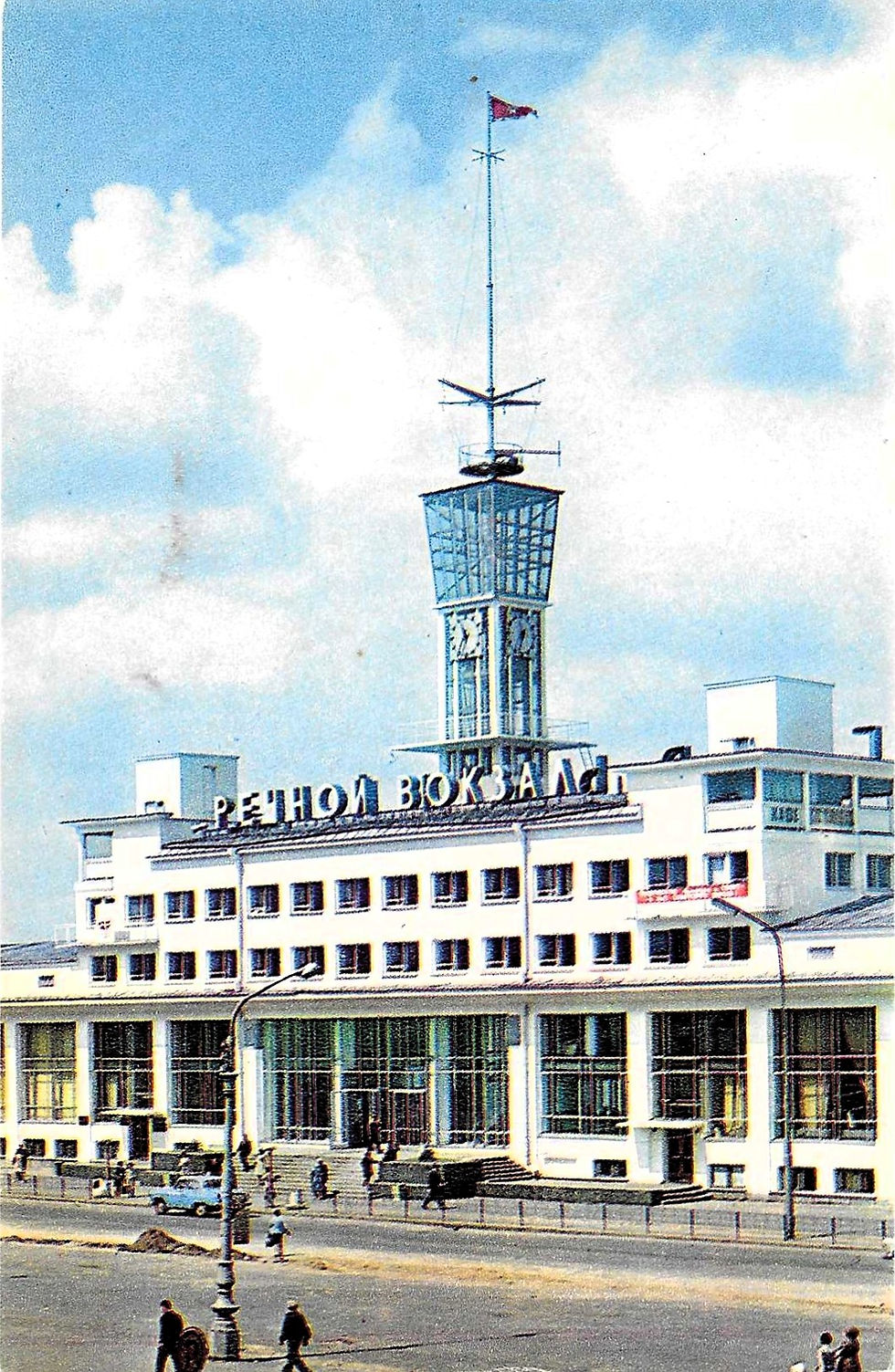
River Station
The USSR developed an extensive and impressive river transportation network. This often involved the use of hydrofoils.
To learn more about see

Staircase to the Volga

Lenin Monument
The Lenin Monument on Kominterna Street was erected for the 10th anniversary of the Great October Revolution on the site of the 1905 barricades.
The sculpture is by V.V. Kozlov.
The monument was built with funds raised by the Sormovo District.

Gorky State Academic Drama Theatre


Comments