


Kafkaesque West: From the Rule of Law to the Age of Unpersons

By Biljana Vankovska
A passage from Margaret Atwood’s The Handmaid’s Tale haunts me often: “That was when they suspended the Constitution… There wasn’t even any rioting in the streets. People stayed home… watching television… There wasn’t even an enemy you could put your finger on.” Today, the enemy list is long: Russia, China, Iran, Hamas—you choose! Our screens have changed, but our passivity hasn’t. We no longer watch TV; we scroll, distracted and numb, as freedoms erode in silence. From this passivity, society has been hollowed out: what remains are not citizens, but masses—zombified, compliant, and increasingly disposable.
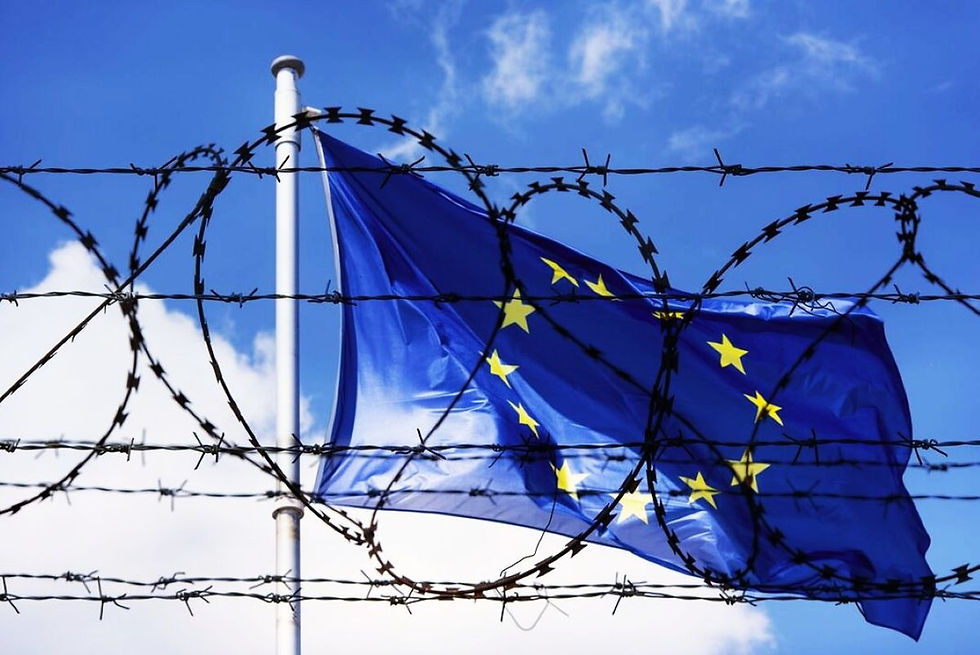
The immediate trigger for this reflection is the EU’s recent adoption of so-called “restrictive measures,” championed by Kaja Kallas and wrapped in Ursula von der Leyen’s Orwellian “Democracy Shield.” Yet the phenomenon is not new, only more visible. The quiet, extrajudicial punishment of individuals has been unfolding for years. The recent sanctioning of Jacques Baud, a retired Swiss intelligence officer and frequent podcast guest, disturbed parts of the alternative media precisely because he is “one of us” (a Westerner, not a foreign dissident). His case is not unique; he is one of nearly sixty individuals now branded as threats simply for speaking critically.
What do these “measures” involve? A total freeze on assets, a ban on earning income, and revocation of freedom of movement within the EU. Imagine being cut off from your own bank account, unable to work, stranded wherever you happened to be when the order dropped. Sounds scary indeed! Orwell had a word for such people: unperson.
This is especially jarring given the EU’s self-image as a “value-based community,” an exporter of democracy and rule of law. How did it reach a point where critical intellectuals are treated as security threats? The EU extends its punitive arm beyond its borders, pressuring Western Balkan states, at summits and in communiqués, to adopt similar measures as a condition of alignment. In effect, it is saying: “to be like us, you must first learn to erase your own.” Some of us are already potential unpersons.
Worse still, these measures operate outside the law. The decisions of the Council of the EU on foreign and security policy are exempt from judicial review. There is no trial, no appeal, no definition of the offense. Acts like “spreading disinformation” or promoting “pro-Russian narratives” become grounds for punishment—not because they are crimes, but because they are deemed inconvenient. This violates foundational legal principles: nullum crimen sine lege (no crime without law), presumption of innocence, habeas corpus, and the right to due process. We are witnessing the collapse of justice into arbitrary power. A reality so absurd it is Kafkaesque.
Sadly, this is nothing new. Recall Julian Assange, imprisoned for exposing war crimes. Or more recently, French ICC judge Nicolas Guillou, sanctioned by the US for seeking arrest warrants against Israeli leaders over Gaza. As Varoufakis pointed out, Europe failed to defend its own citizens. Previously, Germany had banned Varoufakis from speaking on genocide; similar threats target UN officials like Francesca Albanese. The EU, under Kallas, has not resisted this drift; it has refined it, sanctioning its own citizens alongside Russians and Ukrainians. Once, we mocked Kyiv for compiling “pro-Russian” blacklists. Now, the EU has “Ukrainized” itself, adopting and upgrading those very practices.
We don’t even have records or know how many have been sanctioned. An Italian colleague recently recounted how her foundation’s funds were frozen years ago for collaborating with peace groups from Iran and Palestine. Today, people lose jobs for wearing a keffiyeh or expressing solidarity with Gaza. The pattern is clear: dissent is being criminalized under the guise of security.
The fault is ours. We react only to individual cases—usually when the threat nears us. But this is systemic violence against freedom itself. It reminds us of the old warning: “First they came for…”
I live in what can only be described as a semi-colony of the US, the EU, or both (the distinction blurs daily). In the “damned yard” of Balkan political life, sovereignty was surrendered long ago, with little protest. Cancellation is routine. The old servant mentality prevails: “stay quiet; it could be worse.” Now, the worst arrives not with tanks, but with soft power: NGOs, embassies, and technocratic projects that reframe censorship as “resilience.”
Narratives are shaped from abroad. USAID, NED, and Western NGOs and foundations mold young minds. One of my best students just received a human rights award from the German Embassy, days after “restrictive measures” were unveiled. He envisions himself as a future leader, yet says nothing about the rights suspended in the EU he idolizes.
Even more alarming is when local elites internalize this logic. The Macedonian parliament recently passed a resolution banning the opposition from spreading “disinformation”—a euphemism for thought control. Years ago, an NGO carried out a project called ШТЕТ-НА (“Harm-Tive”), aimed at identifying narratives “harmful” to democracy in a state where democracy is already captured. Recently, the UK ambassador announced a new two-year TRACE project along similar lines, with the prime minister smiling beside them. The irony is cruel: society is already silent. Intellectuals hide in ivory towers or mouse holes —or profiteer. Media self-censor. People scroll.
Figures like Baud or Guillou matter not as individuals, but as warnings. Speaking the truth has become dangerous. Months ago, while helping build a multipolar peace network, I argued that solidarity mechanisms were essential, because commitment to peace is now a risk. Some Western colleagues probably perceived me as a coward or paranoid. They didn’t know my second name is Cassandra.
The greatest irony? I learned courage, critical thinking, and intellectual honesty under socialism in Yugoslavia. My father’s ethos was to speak truth to power. That remains mine. For decades, I taught a university course on the European political system and never failed to understand the EU for what it truly is: a corporate-colonial-imperial project cloaked in the rhetoric of peace and justice. Not because I am particularly clever, but because I retained the childlike freedom to declare: the emperor has no clothes.
Now that we all see him naked, will we act? Or will we hide, scroll, and stay silent… until they come for us too?
Biljana Vankovska is a professor of political science and international relations at Ss. Cyril and Methodius University in Skopje, a member of the Transnational Foundation of Peace and Future Research (TFF) in Lund, Sweden, and the most influential public intellectual in Macedonia. She is a member of the No Cold War collective.
This article was produced by Globetrotter.


Comments