


Mirror, Mirror: Trump's NSS and the Illusion of US Strategy

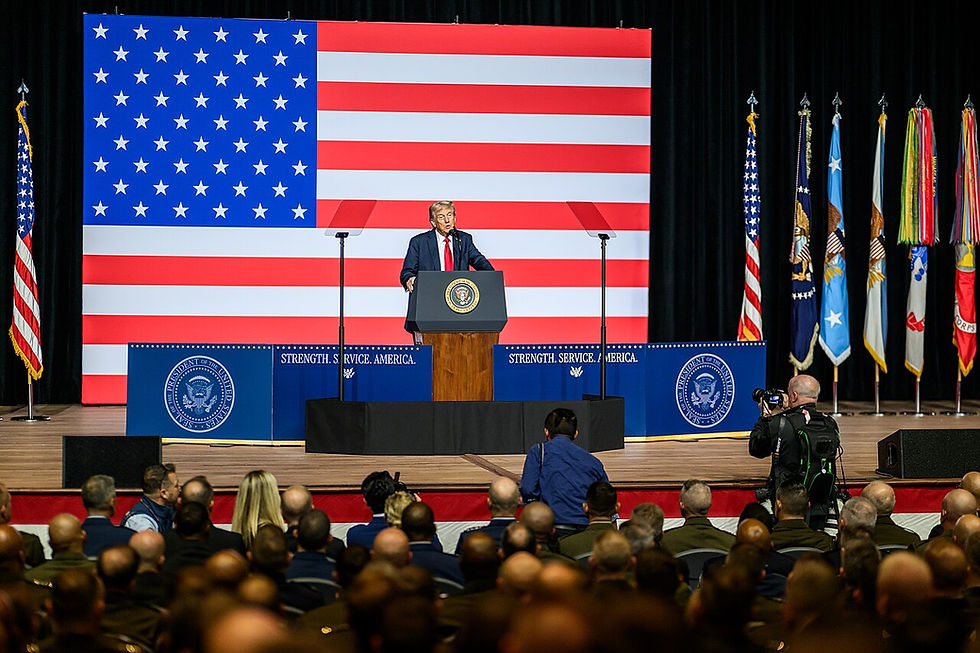
Trump addressing top US military figures in September -- public domain image
By Biljana Vankovska
Like every U.S. administration since the Cold War, the Trump administration has released a document titled the National Security Strategy (NSS). I use the word “titled” deliberately, for if this text were not stamped with the official seal of the United States, it would hardly merit the designation of “strategy.” It is a document that contains little that is strategic and even less that is new. Instead, it offers a repackaged and thinly veiled continuation of the deep-rooted impulses of U.S. imperialism: the unyielding quest for global domination, diplomatically sanitized as “foreign policy.” This core objective remains the one constant in Washington, regardless of the president’s party or personality. Only the rhetoric changes, a superficial gloss applied so that each president can claim a unique and historic legacy.
The document’s poor quality, variously and accurately described by critics as a “buzzword salad” or less coherent than a text produced by ChatGPT, does not absolve us from the duty of analysis. While some intelligent voices in the foreign policy establishment argue for focusing on actions over words, this view is dangerously incomplete. From a constructivist perspective, where language and narratives shape reality, the pronouncements emanating from the world’s highest office produce tangible, real-world effects. The heated, almost panicked debate currently unfolding across Europe’s political and media circles is a case in point.
Once again, we hear the familiar, anxious questions echoing from Berlin to Brussels: Is this the definitive end of the Euro-Atlantic alliance? Are the U.S. and Europe, long described by Robert Kagan as civilizational opposites from Mars and Venus, finally on the brink of a formal “divorce”? This internal fracturing of the West, a political and ideological schism, is perhaps a more compelling and immediate “clash of civilizations” than the one Samuel Huntington ever envisioned. However, to claim this NSS is a “geopolitical earthquake,” as some have, is a dramatic overstatement. The European Union’s strategic decline, its slow slide into geopolitical irrelevance, began long before Trump’s tenure and will, in all likelihood, continue long after. The more critical question is whether the U.S. truly benefits from a policy of radical antagonism that alienates its most loyal vassals and best customers, i.e. the very nations that sustain its bloated military-industrial complex by dutifully committing to NATO’s exorbitant spending targets.
Ultimately, the NSS reads less like a strategic document and more like a tribute crafted for an audience of one. Its vocabulary is a signature blend of Trumpian superficiality, hubris, and a lecturing tone directed squarely at its allies. Much like the sycophantic tailors in Hans Christian Andersen’s The Emperor’s New Clothes, the authors have crafted a text designed to satisfy a profoundly narcissistic leader, reflecting his own grandiose self-image back to him. One can almost hear the guiding principle behind its drafting, a daily incantation before a magical mirror: “Mirror, mirror on the wall, who is the mightiest and richest of them all?” The answer is preordained, even if the emperor is naked. This is a document destined to be forgotten, a transient piece of political theater, perhaps even by its own mercurial subject, who is known to change his mind on strategic issues multiple times a day.
The supposed primary target of this strategy, Europe, is framed as a civilization in need of “repair” (as if the United States today is a paradise of universal values). This is a laughable premise given its own internal crises. This crusade against “Bidenism,” woke culture, and liberal European elites is coupled with the imposition of an U.S.-style xenophobic, proto-fascist anti-migration policy intended to forge a “clean,” white, Christian Europe. Yet, this is largely a distraction, a sideshow. The quarrel with Europe is a dysfunctional marital spat, not a fundamental geostrategic realignment. Europe, trapped in a militarized logic and deluded by nostalgic fantasies of a reborn Fourth Reich, remains a threat only to itself. It will, in the end, remain submissive; the Empire will remain the master. If they fall, they will fall together.
Far more significant is what the NSS projects for the regions beyond the collective West. The proclaimed return to Latin America under a “Donroe Doctrine”, a twisted homage to the Monroe Doctrine, is nothing new. The U.S. never truly left its “backyard”; look at Cuba, for instance. What is new, and deeply dangerous, is the signal of a much firmer, more aggressive hand, one that openly legitimizes war and covert action as tools of discipline and exploitation. Venezuela is the first and most immediate target, where acts of aggression and war crimes are already underway, met with a deafening international silence from the same Western voices so vocally concerned with sovereignty in Ukraine.
Toward Russia and China, the rhetoric may have softened, but the old adage holds true: a wolf may change its fur, but not its nature. Believing the U.S. has genuinely accepted a multipolar world is, as my friend John Ross wittily remarked, like believing a tiger has decided to become a vegetarian. The softer tone is merely tactical. It is a calculated attempt to disrupt the deepening Beijing-Moscow partnership, to pursue new resource deals in the Arctic, and to cynically leave Europe to shoulder the immense burden of sustaining a collapsing Ukrainian state. The underlying containment strategy, evidenced by the reinforcement of the “First Island Chain” around China, remains firmly in place. This is not a strategy for peace, but a tactical timeout in a long-term confrontation.
Stripped of its seductive noise and patriotic platitudes, the Strategy is painfully honest in its core intentions: deeper militarization of the globe, reinforcement of Cold War-era containment policies, and the pursuit of a “global NATO” to replace the faltering European original. The talk of the “Western Hemisphere” is simply a euphemism for a new colonial crusade, an effort to plunder the Americas for the resources needed to fuel its own desperate attempt at self-preservation. Russia, China, and Iran remain the primary targets, with the document’s only change being a slightly more subtle formulation: “avoiding domination by any other competitor.”
Ultimately, this incoherent and contradictory document reveals not the strength, but the profound weakness of a declining empire. The United States has lost its compass and lacks strategists capable of navigating a new and complex era. It remains dangerous, not because of a grand strategic vision, but because of its immense military might, now wielded by a reckless administration long divorced from international law and the UN Charter. This amateurish NSS is a declaration of war, a blueprint for plunder, and a confession of weakness. The U.S. no longer has the power to reshape the world in its image, but as the ongoing aggression against Venezuela and the genocide in Gaza tragically prove, it still has enough power to harm the new world struggling to be born.
Perhaps we have wasted too much energy on the obvious: a document not worth the paper it’s printed on. Our real problem is the slow mobilization of the Global Majority to prevent the catastrophe that will accompany the Empire’s final days. Our task, for those of us from below, is to act as midwives to a new and better world, not merely as interpreters of a decaying one. This follows the wisdom of Marx himself, who taught that the point is not simply to interpret the world, but to change it.
This article was produced by Globetrotter. Biljana Vankovska is a professor of political science and international relations at Ss. Cyril and Methodius University in Skopje, a member of the Transnational Foundation of Peace and Future Research (TFF) in Lund, Sweden, and the most influential public intellectual in Macedonia. She is a member of the No Cold War collective.


Comments