


Nuestra América Convoy a symbol of global solidarity with Cuba


Photos via Photo: Estudios Revolución
By René Tamayo León, translated from the Spanish
The Nuestra América Convoy "is an eloquent example of what the peoples of the world are capable of doing when defending a just cause. It is the result of a great effort made by dozens and dozens of organizations that have responded to the call of the Progressive International to break the siege and carry a message of hope and profound humanism."
Fernando González Llort, the president of the Cuban Institute of Friendship with the Peoples (ICAP), highlighted this point on March 21 while greeting the caravan members at the headquarters of this iconic institution known for fostering international solidarity between Cuba and the peoples of the world. The event was attended by Miguel Díaz-Canel Bermúdez, the First Secretary of the Central Committee of the Party and President of the Republic.

Accompanying the President and other national leaders, the convoy included over 600 friends from various regions, representing 300 organizations across 33 countries, all collaborating to bring this wonderful initiative to life.
Caravanners, representing a diverse range of generations and peoples of the world, are involved in solidarity associations, social movements, NGOs, trade unions, political parties, parliaments like the European Parliament, as well as religious, youth, and cultural organizations, including Cubans residing in various locations.
These individuals have successfully provided crucial material aid to our people and continually offer their support and solidarity, showing that Cuba is not, and will not be, alone.
"Each of those volunteers, each of these organizations, each of those 33 countries are an open wound on the imperial siege, irrefutable proof that international solidarity is still alive, continues to fight and continues to arrive," said Fernández Llort.
"You," he said, "have decided to accompany us and send a strong message of solidarity at a complex and sensitive time for Cuba. We are deeply grateful."
Also in attendance at the welcome were Esteban Lazo Hernández, the president of the National Assembly; Manuel Marrero Cruz, the Prime Minister; and Roberto Morales Ojeda, the Secretary of Organization of the Central Committee, along with other members of the Political Bureau, ministers, and figures from various sectors of national life.

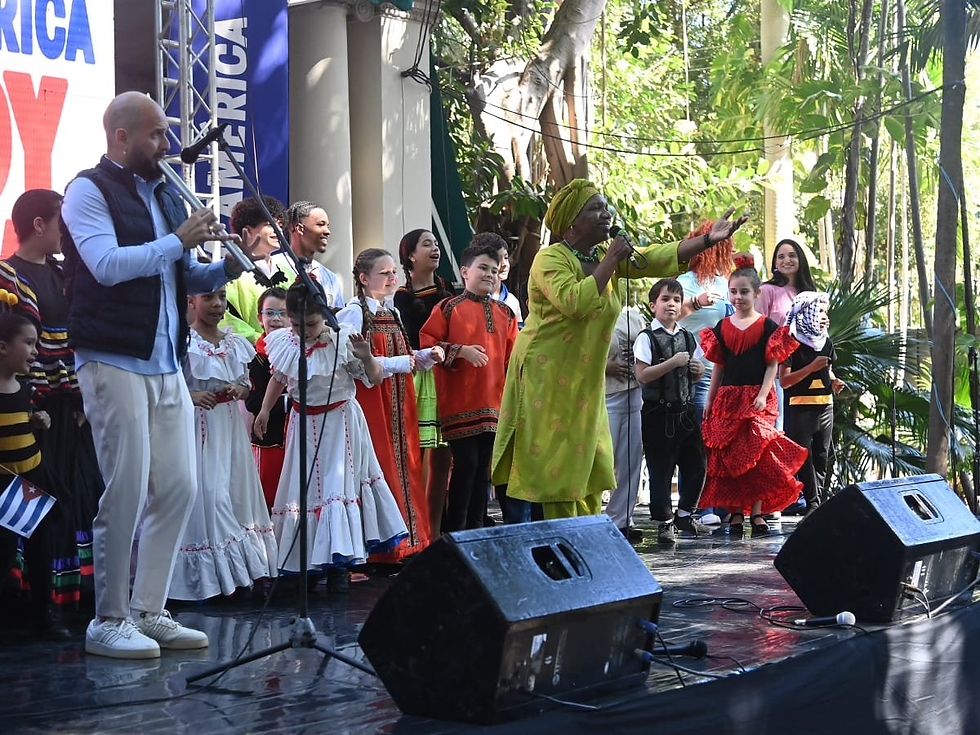
The meeting at the ICAP began with a presentation by the La Colmenita Children's Company, who performed the iconic song "Blowin' in the Wind" by Bob Dylan which invites reflection on the human condition, peace, war and freedom.
EFFORT FULL OF LOVE, SOLIDARITY, MILITANCY
David Adler, co-general coordinator of the Progressive International, addressed the meeting by discussing three key themes: solidarity, militancy, and his identity as a US citizen.

No other people in the world have endured a more prolonged and criminal blockade, lasting over 65 years, which has now been further intensified by an energy siege. This relentless aggression is something only the Cuban people have been able to withstand. This is why the bond that unites us is one of solidarity, he stated.
As a militant fighting for a better world, Adler said that what is at stake here is to defend an idea, an example, that real project that Cuba represents with the achievements of its revolution.
As a U.S. citizen, the leader of the Progressive International claimed that Americans "have a particular responsibility, we have an obligation to fight against the genocidal policy of our government in Gaza, in Iran, in all of America."

"With the Monroe Doctrine, Donroe as Trump calls it," he added, "a century of anti-colonial struggle is at risk. That is why we are here in Cuba, because to fight for Cuba is to fight for all humanity, to fight for the right to self-determination of all the peoples of the world."
"And this," David Adler pointed out, "will not be the last caravan; we are going to continue calling on the world to defend Cuba."
Manolo de los Santos, executive director of The People's Forum, described the Nuestra América Convoy as an effort full of love, solidarity, militancy, and a symbol of those "millions and millions of human beings who refuse to turn our backs on the Cuban people."

"The people of Cuba," he commented at the beginning of his remarks, "have given the greatest lesson in resilience, in resistance; an example of what it means to create a real alternative against the horror of capitalism, of imperialism."
"Thank you Cuba for inspiring our efforts to want to change the world."
"Taking away from a people the right to life, peace, fuel, health, is genocidal," he said, adding "Cuba does not need us, we are the ones who need Cuba. The world needs the Cuba of solidarity, the Cuba that sends its best children, its teachers, its doctors, to any corner of the planet as angels of solidarity."
When describing the experiences of the over 600 members of the Nuestra América Convoy currently on the island, Manolo de los Santos highlighted that they have had the opportunity to listen to and meet "a people that is not going to give up; to a people willing to give their lives for humanity and in their own defense."

But, he added, "our struggle does not end with Cuba, our struggle is not only for peace, but to change the world; we want a world without sanctions, without blockades, without genocide, without war against Iran; a world in which Palestine is free, Puerto Rico is free, Western Sahara is free."
MEP Enma Fourreau, a key figure in the caravan delivering aid to the Palestinian people in the Gaza Strip, stated that the global community should never submit to US imperialism. She demanded that the killing of children in Gaza and Iran must end, and that people in Cuba no longer be deprived of medicines.
"If we look away it will always be the same." She emphasized the significance of having over 600 militants from around the world currently in Cuba with the Nuestra América Convoy "In that Cuba," she stated "that taught us internationalism, solidarity, friendship."

Bianca Borges, the young president of Brazil's National Union of Students, highlighted that being in Cuba today symbolizes a renewal of hope for the struggle towards a free and unified Latin America without discrimination.
WHEN THE PEOPLE DEFEND A JUST CAUSE
During the key remarks of the welcome ceremony for the members of the Nuestra América Convoy, Fernando González Llort, the president of ICAP, stated that this "is an eloquent example of what the peoples of the world are capable of when a just cause is being defended."

In reviewing the latest acts of aggression by the U.S. government against various countries, he condemned how "decadent imperialism, with grotesque arrogance and impunity, has dangerously imposed on the world the law of barbarism and force over reason, dialogue and collaboration.
A government, he added, that "does not grant the slightest respect to the basic principles for peaceful coexistence among nations, nor to the sovereignty, human dignity and self-determination of our peoples."

Referring to the executive order issued by the occupant of the White House on January 29 to restrict Cuba's access to fuel, he noted that "to justify this new escalation, the U.S. government constructed a web of false pretexts that we must face with the force of truth."
"The method has been to construct the lie, repeat it ad nauseam, dress it up as supposed official intelligence and then use it as a pretext to escalate the aggression. It is," he explained, "the same cynicism with which they include us in unilateral lists, the same cynicism with which they support the genocide of the Palestinian people, the same cynicism with which they lie to intervene militarily in the world, the same cynicism with which they declare themselves defenders of human rights, but then use minors to arrest their migrant parents."
"The new measures associated with this recent executive order," commented the President of ICAP, "are aimed at establishing a total energy blockade against our country. It is not just another measure; it is the deepening of an energy war designed to strangle our economy, break our resistance and punish an entire people for the crime of insisting on being free and sovereign."

However, despite all these aggressions, Fernández Llort mentioned regarding the Nuestra América Convoy, "here is the solidarity response from the peoples, which has been immediate, driven by the recognition of such injustice and brutality."
He highlighted how "globally, numerous voices have emerged, supported by an extensive network of organizations that go beyond the traditional solidarity movement with Cuba and have drawn the political support, moral support and material support of political forces, social and popular movements, pacifist and youth organizations, trade union collectives, of women, parliamentarians, and influential cultural and academic figures."
He commended the role of digital activism in supporting Cuba's fight for resistance and dignity, noting that it has served as a force multiplier by enhancing visibility and mobilizing allies through campaigns, publications, and articles in available media, thereby ensuring ongoing attention and exposure for the various actions undertaken.

"The people of the world who have been with us until now and who we are confident will continue to stand by us," he said, "have realized that backing the Cuban Revolution in its resistance is also a part of their fight for a more equitable world and for global peace, which is currently under significant threat from imperial interests. These interests, in their desperate decline, persist in fueling the arms race and seizing natural resources from other nations, exacerbating environmental degradation and causing severe humanitarian crises."
Fernández Llort denounced the unprecedented psychological warfare to which the Cuban people are subjected, which seeks to "sow discouragement where there should be certainty, fracture our unity and make us doubt our own strength."
"But," he clarified, "the legacy of Fidel Castro Ruz stands as a symbol of unwavering dignity, offering an enduring lesson that resistance is not passive but rather a continuous offensive driven by intelligence, morality, and conscience.

"Fidel," he said, "taught us that wars are won when the people do not surrender; he also taught us to identify the false pretexts of the enemy, because he himself faced them throughout his life, from the lies of the Bay of Pigs invasion to the slanders about the Cuban internationalist presence in Africa. He left us the formula to defeat the lies: Truth, unity, conscience and action."
In Cuba, Fernández Llort ratified, "we will not retreat, because to surrender would be to betray our own history. We will defend each conquest with the conviction that the homeland is not a disputed territory, but an idea for which those who knew that without it we are nothing, have given their lives."
To the over 600 members of the Nuestra América Convoy, the President of ICAP characterized their efforts as a representation of that "humanity that organizes, mobilizes, travels, embraces."
"You," he told them, "represent the certainty that no imperial siege will ever be able to imprison the dignity of the peoples, because the homeland we defend, that of Martí, that of Fidel, that of those who have fallen and that of those who resist, is not a strip of land under siege, but a piece of humanity that refuses to give up. That is why we say with all the strength of our history and our conviction, homeland is humanity and you are its most beautiful expression."

This work was translated and shared via a License CC-BY-NC


Comments