


Quebec National Politics In The Era of Trump

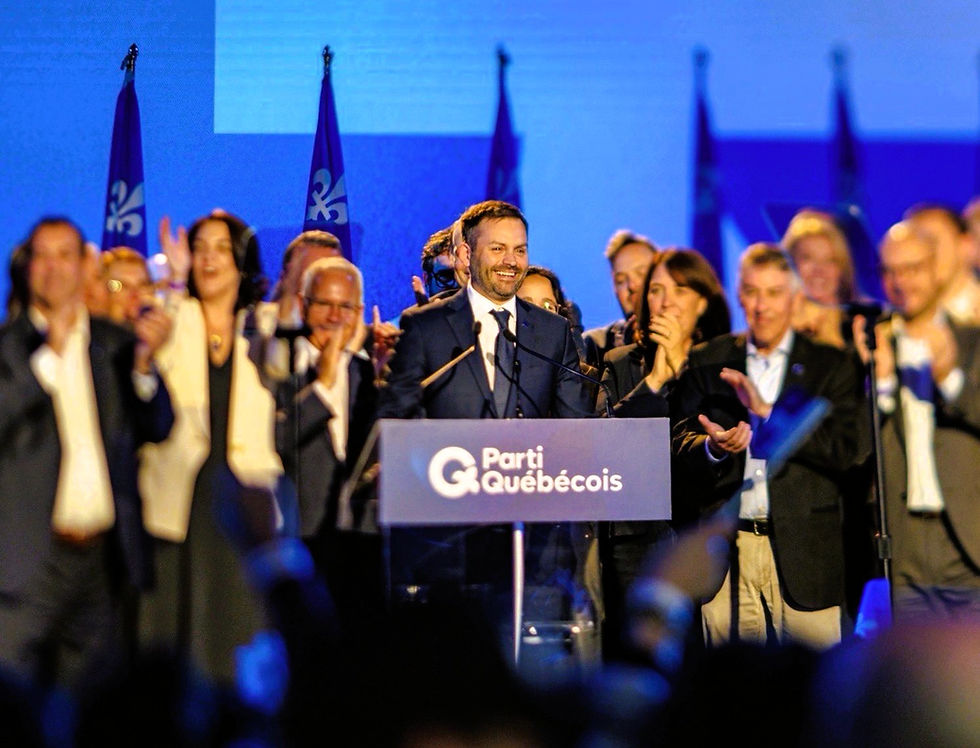
Paul St-Pierre Plamondon on election night -- image via Paul St-Pierre Plamondon on X
By Gabriel Haythornthwaite, The DNA Report
With only 8 days until Alberta’s pre-annexation referendum, The DNA Report engages a third round of This Week In Annexation with commentary on the minority government victory of the Parti Québécois (PQ) on October 5. This event, returning the PQ to power with 59 seats after a decade in the political wilderness (they won a pitiful three seats in 2022), has resurrected the national independence question in a new context shaped by both the Trump-USA push for ‘51st state’ annexation and an energetic far-Right ‘separatist’ drive in Alberta.
The Return of the National Question in Quebec
The PQ victory was secured with the lowest plurality (28%) in the province’s history due to a uniquely competitive five-party contest. In contrast to indulgent appeasement attitudes in English Canada towards Albertan ‘separatism’, the return of the national question in Québec—31 years after the razor-edge result of the second sovereignty-association referendum—has put the establishment on a yellow-alert status.
Premier-elect Paul St-Pierre Plamondon campaigned on the flagship promise to hold a third referendum in the PQ’s first term. However, with the PQ being five seats short of a majority and St-Pierre Plamondon making an election pledge to hold off on an independence vote until Trump’s supposed exit in 2029, the Canadian establishment are cautiously optimistic that this danger of national equality will pass.
The PQ independence plan consists of a five-step ‘road-map’ centred on a new constitution:
1) One to two years of studies and travelling roadshow consultations on a provisional constitution.
2) National Assembly ratification of the provisional constitution and the holding of an independence referendum.
3) The referendum will be held in 2029 or 2030 with a ‘yes’ vote ratifying the provisional constitution and sanctioning the formation of a new country.
4) The creation of a Constituent Assembly after a ‘yes’ vote to draft a permanent constitution (two to four years).
5) Within three more years, a second binding referendum will be held to ratify the permanent constitution after which the National Assembly will finalize the jurisdictional powers of Québec state agencies.
The Trump-USA Horsefly in the Quebec National Ointment
In contrast to the firm opposition of the Canadian establishment, the far-Right in Alberta and one of its American fascist billionaire fans publicly welcomed the prospect of a Québec independence vote. Jeff Rath, preeminent Albertan annexationist and a most untrusted administrator of First Nations’ trust funds, pushed his hefty endorsement on anti-social media. Meanwhile, sieg-heil-enthusiast Elon Musk did likewise, subtly combining his approval of Québec developments with a call for Alberta and Saskatchewan to likewise leave Canada.
Governor Danielle Smith and Saskatchewan sub-Premier Scott Moe feigned outrage at the Musk call for ‘separation’, affirming their dedication hand-over-heart to the corporate-colonial order in Canada. Sub-Premier Moe also took pains to emphasize that he is prepared to do as Governor Smith has done, i.e., to hold a ‘separation’ ballot in Saskatchewan despite apparently being fully committed to Canadian federalism. As with Smith, Moe simply wants to give his residents a say in their future though not on any aspect of his government’s hard-Right economic agenda in the service of big business.
Muddying the waters of a Québec national agenda with the muck of Trump-USA politics, St-Pierre Plamondon effectively endorsed Albertan ‘separatism’ during a Calgary visit in September 2025. The PQ leader doubled down on this support in a statement this past June directly equating the Québec national movement with the prairie province’s autonomy pretensions.
What is more, St-Pierre Plamondon and Rath linked up personally over dinner in Calgary last year and the two lawyers (Lord, spare us) have reportedly continued a friendly contact since. While the PQ is cool to ‘transit’ fossil fuel pipelines from Alberta through Québec, the party under St-Pierre Plamondon has also adopted hard-Right policy against immigration along lines similar to those of Smith’s UCP regime.
The PQ also campaigned in the election on lowering the corporate tax rate, another longstanding rightwing obsession. This policy alignment may suggest that a PQ alliance with Albertan annexationists is more than merely a matter of coincidentally shared political interest against Canadian federalism. This alliance will likely make ‘separatist’ politics prominent across Canada for years to come.
Two Trends in the Quebec National Movement
In typical Anglo-arrogant style, the Canadian establishment has optimistically assessed that the prospects for Québec independence are only contained within the low 28% plurality of the PQ vote on October 5. There is, however, a second sovereigntist party; left-social democratic Québec Solidaire (QS) won nine seats and 12.4% of the vote. QS has a considerably different approach to independence from that of the rightwing PQ.
Despite this political division in the sovereigntist camp, combined PQ and QS MNA representation could secure a parliamentary majority for a St-Pierre Plamondon government. This means there is a highly plausible basis for a new national independence drive during the PQ’s minority term. And the combined vote of the two parties was just over 40%, which is a much higher initial floor of support for independence than the miserable ~25% that the Albertan annexationists have had to play with over the past six months.
Getting to an agreement on how to approach independence will no doubt prove challenging when the specifics of the PQ and QS plans are considered. The PQ plan, summarized above, is a highly bureaucratic one which also rejects agreement with Indigenous nations. The Trump-USA influence on the PQ is also evident in the party’s vision of a Québec republic committed to both NATO membership and the lunatic 5% GDP largesse to warfare expenditure dictated by Herr Trump. The PQ may envision independence from Canadian federalism but clearly not from the American Empire.
QS opposes militarization including public handouts to corporate warfare industries, the NATO war alliance and its obscene ‘defence bank’ which is due to be placed in Montréal. The party’s independence plan is noteworthy for its democratic nation-to-nation approach by which Québec would be founded as a ‘multinational’ state in partnership with Indigenous nations. Unlike the PQ ‘roadmap’, the QS model of constitutional development would feature constituent assemblies which include First Nations and Inuit participation at their discretion.
The QS vision and approach to Québec independence is quite compatible with The DNA Report’s political formulation of free and equal nations. This formulation is explicitly in democratic opposition to both American Annexation and Canada’s uni-national 1867 colonial Confederation set-up, enshrined in the 1982 Constitution. The QS proposal for national realignment in Québec can be drawn upon to guide the development of a democratic movement in the rest of Canada for a new political federalism based on the priorities of the working majority in each nation.
Sign up to follow The DNA Report at: It Can’t Happen Here? - The DNA Report
Gabriel Haythornthwaite is a former labour-allied school board trustee in BC and currently advises First Nations around political and intergovernmental relations. He is also a leftwing writer and political organizer.


Comments