


Repression and Security at the NATO Summit


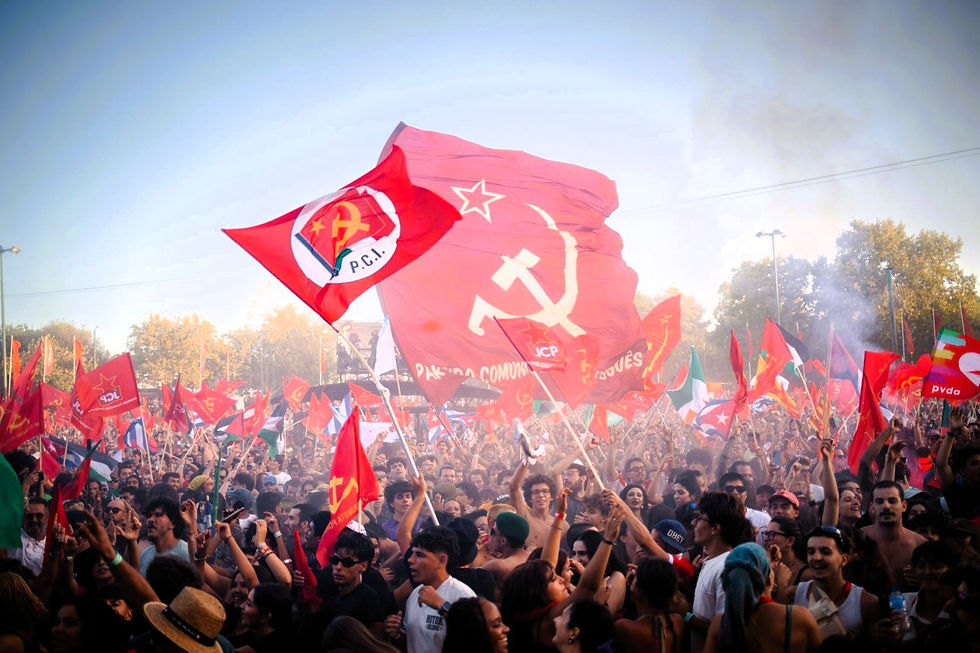
Get out, NATO! Protest before the summit on June 13 in Ankara
By Tunç Türel in Ankara. junge Welt, July 2, 2026. Translated by Helmut-Harry Loewen.
Ahead of the NATO summit on July 7 and 8, the Turkish government is transforming the capital into a security zone. Protests are banned, socialists arrested, social media blocked. While billions have been made available for official transit routes, runways and facades, residents are paying the price with bans, controls, traffic blockades and loss of wages. What is happening in Ankara is therefore more than the preparation of an international summit. The NATO visit reveals how inextricably foreign policy alliance loyalty, internal repression and the transformation of urban space are connected.
The summit of NATO heads of state and government will take place in the presidential complex in Beştepe, the political centre of the ruling Justice and Development Party (AK PARTİ). Even before the meeting begins, what this means for the population is clear: barriers, bans, raids, censorship and a city that is being prepared to meet the requirements of an imperialist military alliance.
Ban on gatherings
Officially, the government does not speak of a state of emergency, but its practices are its instantiation. The governor's office of Ankara has banned almost any form of public political activity for the period from June 28 to July 10, i.e. for two weeks. Demonstrations, meetings, press conferences, hunger strikes, sit-ins, rallies, information stands, tents, the distribution of leaflets and brochures, and the displaying of posters and banners are prohibited. School examinations, symposia, panel discussions, graduation ceremonies, festivals, concerts and similar events are also to be suspended. This will prepare the city politically and socially for the summit. The measures are justified by invocations of the summit’s “security,” "public order," "national security" and the protection of foreign delegations.
The ban is applicable not only to the immediate vicinity of the meeting place. It affects the entire city, especially areas defined as "sensitive": the routes of the delegations, their hotels, the presidential complex, airports and central transport axes. This constricts the political space of the capital in the name of NATO. Those who hope to engage in protest against the war alliance must not even be seen. Anti-imperialist contradiction is not treated as legitimate political expression, but as a disruption of security.
A broad wave of repression ensued shortly after the bans were announced. In the early morning hours of June 23, numerous apartments were searched in Ankara at the same time. "As part of the measures to expose the nationwide activities of terrorist organizations," arrest orders were issued against 241 people, 225 people were arrested, 178 of whom were subsequently placed in pre-trial detention. Most of them are active in left-wing or socialist spaces, but also in legal and trade union organizing projects. Among others, the associations New Democratic Youth (Yeni Demokrat Gençlik), the People's House Movement (Halkevleri), the Federation of Socialist Youth Associations (Sosyalist Gençlik Dernekleri Federasyonu), the Movement for a Free University (Özgür Üniversite Hareketi), the Association of Contemporary Lawyers, the People's Legal Office and the solidarity network "Union of Hope" (Umut-Sen) have been targeted.
In addition to physical repression, there is digital repression. Following the arrests, numerous social media accounts of revolutionary parties and youth organizations, individuals and media outlets were blocked. The shutdowns were justified by "national security" and "public order." Protests are to disappear from the streets and deleted from digital space.
Socialist associations and youth organizations have not remained silent despite bans on gatherings, arrests and massive police deployments. Last Sunday, actions against NATO took place in Istanbul in front of the Trump Towers, as well as in Ankara and Izmir. On Monday, there were protests in Istanbul against the NATO parliamentary summit meeting. Demonstrators marched through the streets, temporarily blocked traffic and were eventually stopped by the police. Eleven people were arrested.
At the same time, Ankara is being dressed up for NATO. Around ten billion lira (about 188 million euros) in public funds are said to have been mobilized for preparations, infrastructure and security measures for the summit. The Etimesgut Air Base, just a few kilometers from the presidential complex, has been prepared for the arrival of the heads of state and government. The roads between Etimesgut, the presidential complex, the new military headquarters, the headquarters of the secret service and important protocol routes have also been improved or expanded.
At the expense of the population
These sums show the class character of this preparation. For the work at the airport alone, contracts worth over five billion lira (about 96 million euros) were awarded. For the expansion of the road connections to the presidential complex, the contract value is almost four billion lira (about 75 million euros). In addition, there are planning and consulting services as well as contracts for "vertical gardens" along the transit routes, which are expected to cost almost seventy million lira (1.3 million euros). The city is not being repaired in the interests of its residents. It is being readied for NATO's cameras, convoys and security requirements.
The traffic measures are also mainly at the expense of the population. Under the designation of a "red zone," the routes between Esenboğa, Etimesgut, Beştepe, Çankaya and the hotels of the delegations are controlled. In certain areas, pedestrian and vehicle movements are to be restricted, main traffic arteries are to be temporarily or completely closed, and access roads to streets and districts are to be blocked. Anyone who works, commutes or lives near these zones must subordinate themselves to the needs of state guests.
Hunting street dogs
The city is also undergoing a disciplining through aesthetics. Along the official transit routes, facades are being painted, landscaping work is being accelerated, roads are being smoothed. On the median strip of the street in front of the U.S. Embassy, vases and columns in the ancient Greco-Roman style have been placed. According to reports, even poor-looking houses or “gecekondus“ (informal settlements, jW) along certain stretches have been covered with panels to prevent "visual pollution." The political logic is unmistakable: poverty is not to be eliminated but rendered invisible. It is not social inequality that is the problem for the rulers, but that it could be seen along the routes traveled by NATO convoys.
The "aestheticization" of the city has even affected street animals. The police department is said to have instructed the district administrations to round up stray dogs along the protocol routes, at hotels and at venues and to bring them to animal shelters, whose conditions have long been criticized for overcrowding, neglect and miserable living conditions.
The situation is similar with reports that parks such as the Botanical Garden, the Dikmen Valley or Lake Eymir could be temporarily closed so that French President Emmanuel Macron can complete his morning run. There were official denials of this, but in a city where demonstrations, leaflets, festivals and concerts are banned, the very idea that a park could be reserved for a head of state seems like a accurate summary of the prevailing order. The residents are not allowed to protest, but the powerful are supposed to move about undisturbed.
The government defends these measures in tones of hospitality and state responsibility. There is neither martial law nor a state of emergency, it claims, but only the temporary, legally covered security measures that are common everywhere at international summits. But Ankara shows that "security" is not a neutral term. Security here does not mean protecting workers from poverty, exploitation, housing shortages or police violence. Security means unimpeded travel for heads of state, undisturbed protocol routes, controlled hotels, shielded streets and the displacement of anti-imperialist forces from the public sphere. NATO's security comes at the cost of the people’s insecurity.
The Turkish bourgeoisie and its state present themselves as reliable hosts of an imperialist war alliance. The state's repressive capacity to secure a foreign policy objective ensures that NATO can meet without having to hear the objections of those who take to the streets in opposition to war, rearmament and imperialism.
Original article: Im Belagerungszustand. Türkei: Zum NATO-Gipfel in Ankara präsentiert sich die Regierung als verlässliche Gastgeberin des Kriegsbündnisses. Von Tunç Türel, Ankara. junge Welt, 02.07.2026.
The author, Tunç Türel, completed an undergraduate degree in German Language and Literature, his master's degree in History at Hacettepe Üniversitesi (Ankara), and his doctorate on Ancient Greece and Rome at Univerzita Karlova (Prague).


Comments