


Selected Works of Raúl Castro Ruz launched in Havana

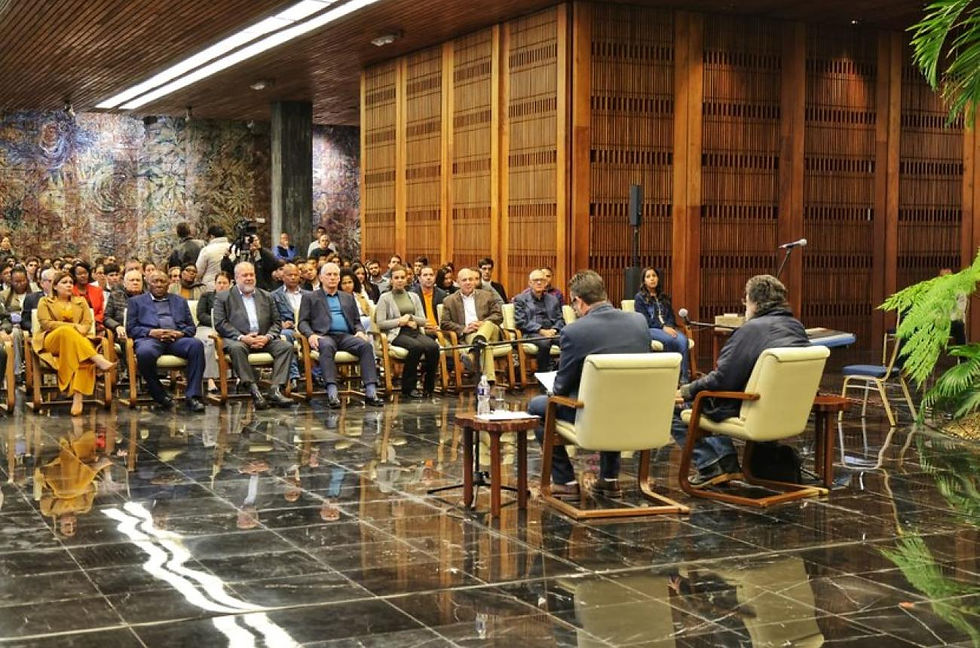
The Selected Works of Army General Raúl Castro Ruz, a nine-volume compilation, were presented at the Portocarrero Hall of the Palace of the Revolution in Havana before an audience of young Cubans, highlighting his leadership, historical role, and ethical guidance for future generations

Images via Estudios Revolución & the PCC
Various Sources
On February 24, 2026, the Portocarrero Hall of the Palace of the Revolution hosted the presentation of the nine-volume Selected Works of Army General Raúl Castro Ruz, attended by around one hundred young Cubans, including students from the Vladimir Ilich Lenin Pre-University Vocational Institute of Exact Sciences and representatives from varied sectors of Cuban society. The date was symbolically significant, marking multiple historical milestones in Cuban history, including the commencement of the liberation struggle in 1895 and the proclamation of the first Socialist Constitution in 1976, when Raúl delivered the keynote address.
The Selected Works span over 5,000 pages and include more than 500 documents from Raúl Castro's political and personal life, enriched with over 2,070 footnotes. Each volume contains QR codes linking to historical images of Raúl at various stages of his life. The editions are not merely decorative but serve as a comprehensive resource for understanding Cuban history, revolutionary ethics, and leadership principles. The compilation was developed over four years of research at the Office of Historical Affairs and published by Ediciones Celia. A digital version is accessible on the Cuban Presidency’s website.
The prologue was written by President Miguel Díaz-Canel, who was at the launch, emphasizing Raúl Castro as a figure who valued life and fought for national causes, and framing the volumes as both an historical and moral guide.
Historian Elier Ramírez Cañedo, Deputy Head of the Ideological Department of the Central Committee, described the collection as an “ethical compass and arsenal of ideas”, offering young people a model of revolutionary leadership.
.
Abel Prieto Jiménez, President of Casa de las Américas, highlighted Raúl’s humanism, his educational vocation, and his distinctive Cuban colloquial style, noting the presence of Celia Sánchez as a constant influence throughout his writings.
.
The works reflect Raúl Castro’s strategy, defense and construction of the Cuban Revolution, statesmanship, and ideology, positioning him as a guide for ethical and political conduct in contemporary Cuba.
The presentation was explicitly aimed at Cuban youth, emphasizing the importance of learning and debating history while confronting modern distortions or oversimplifications. Other leaders present, included Prime Minister Manuel Marrero Cruz, Vice President Salvador Valdés Mesa, and Secretary of the Council of Ministers José Amado Ricardo Guerra, praised the collection for its detailed account of Raúl’s role over the past seven decades and as a systematic resource for revolutionary education and reflection.



Comments