


The dignity and strength of a people are worth more than any imperial power: 65 years after the Bay of Pigs


Images via Favio Vergara, JR
By Katherin Hormigó Rubio, translated from the Spanish
It was an emotional morning on April 14 at the Fidel Castro Ruz Center, during a talk with Cienfuegos fighter Ramón González Suco, who, at just 22 years old, took part in the historic Battle of Playa Girón. With emotional words and a determination that the events of April 1961 be remembered, González Suco captured the spirit that drove hundreds of young Cubans during that remarkable feat.
Speaking to the press, the Cienfuegos fighter emphasized that “in Girón, we learned that the dignity and strength of a people are worth more than any imperial power.” His personal testimony was one of the most moving moments of the first day of the academic workshop “Girón, 65 Years After the Great Victory Against Imperialism” which is taking place April 14 and 15 at the Fidel Castro Ruz Center in Havana.
As part of the celebrations for the 65th anniversary of the victory and the Centennial of Commander in Chief Fidel Castro, the event gathered historians, journalists, researchers, and leaders from the Communist Party of Cuba, the Revolutionary Armed Forces, and the Union of Young Communists to discuss the historical importance of Playa Girón and its relevance in the face of today’s imperialist threats.
The day kicked off with Yuniasky Crespo Baquero, a member of the Party’s Central Committee and head of the Ideological Department, leading the opening alongside other top officials from the Party, State, and Government.
Dr. C. René González Barrios, director of the Fidel Castro Ruz Center, began the inaugural conference by exploring the role of the United States Armed Forces in the CIA-organized mercenary invasion and its ties to the Guantánamo Naval Base.
González Barrios emphasized that during the roughly 66 hours of combat, the experience gained in irregular warfare was combined with aspects of conventional warfare, which proved crucial in defeating the enemy. "We live today in a geopolitical context of rearrangement of the hegemonic powers and the decline of American imperialism," he said, and remembered the example of the 32 Cubans who gave their lives in the line of internationalist duty in Venezuela.
One of the central moments of the day was the presentation of the book "Playa Girón: 65 Years After That Socialist April", compiled by Elier Ramírez Cañedo, deputy head of the Ideological Department of the Central Committee of the Communist Party of Cuba, and published by Ocean Sur.
Ramírez Cañedo explained that the work compiles significant interventions by Fidel Castro during and after the battle, complemented by images and a detailed timeline of events. "We think of this compilation as being mainly for young people, but it will be enjoyed by the public as a whole," he said.
The researcher stressed that the Bay of Pigs was not only a military confrontation: "It was a political, communications and cultural battle, led by Fidel and supported by the entire people." He remembered that the proclamation of the Revolution’s socialist character on April 16, 1961 was a landmark cultural event, as the fighters defended not only national independence but also the banner of socialism.
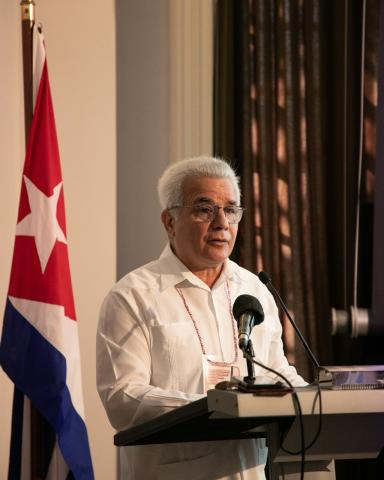
"When one reads Fidel in that context and the reflections he made on Girón at other times in the history of the Revolution, it seems as if he was talking to us of today," Ramírez Cañedo emphasized. He also stressed the importance of making these primary sources accessible to younger generations, noting that without understanding the Bay of Pigs, it’s impossible to fully grasp later events like Operation Mongoose or the October Crisis.
The workshop also included specialized workshops: "Background of Operation Pluto", by Andrés Zaldívar Diéguez, president of the Provincial Executive Committee of the Union of Historians of Cuba; "The Mercenary Brigade and the Invasion Plan", given by Colonel Raidel Vargas Ortega, from the Center for Military Studies of the FAR; and "The Fight Against Bandits in April 1961," presented by Pedro Etcheverry Vázquez, director of the Center for Historical Research of State Security.
After the screening of the Latin American ICAIC film "Death to the Invader", the participants agreed that the lessons of Playa Girón remain a guiding light in today’s geopolitical climate, shaped by the rearmament of the hegemonic powers and the ongoing threat to Cuba.
Ramón González Suco, a member of the 339th Battalion from Cienfuegos, shared how his unit was deployed to Central Australia and how he, along with four fellow soldiers, was stationed at an observation post in Playa Larga. He recalled how the invaders screamed and leapt into the water, but then the machine gun they had only just learned to use a few days earlier jammed. That moment gave them the chance to raise the alarm and slow the enemy’s advance.
At the end of the first day, the attendees reaffirmed that the freedom won at the Bay of Pigs is defended every day, and that their example continues to light the way for the Cuban nation and all the peoples of the Americas, who, since the Bay of Pigs, have been “a little freer.”
The academic workshop will conclude Wednesday, April 15 with new sessions of debate and analysis.
This work was translated and shared via a License CC-BY-NC


Comments