


The Latvija minibuses of the USSR


The "Latvija" (Latvia) minibuses, produced by the Riga Autobus Factory (RAF) from 1959 until 1997, were iconic Soviet vans widely used across the USSR in public transport, as ambulances, and for various state services.
The Riga Autobus Factory (RAF) was founded in 1949 in Riga, Latvian SSR, initially producing bus bodies on the chassis of existing trucks, such as the GAZ-51. In 1955, it was reorganized as the Riga Experimental Bus Factory and became a central producer of minibuses and vans for the Soviet Union. Inspired by the Volkswagen Type 2, the RAF team introduced its first prototype minibuses in the late 1950s, with serial production of the RAF-977 Latvija beginning in 1959. These early vans accommodated ten passengers and were used for a variety of purposes including ambulances, route taxis, mail, and cargo transport.

RAF-977 -- Riga Motor Museum

The ambulance version of the updated RAF 977D Latvija.
In 1976, a new factory was completed in Jelgava to produce the RAF-2203 Latvija, the successor to the RAF-977. This factory was designed to produce 17,000 vehicles annually and created an entire worker settlement, which significantly increased the population of Jelgava during the Soviet era. To support the workforce, the Soviets built a dedicated residential neighborhood and infrastructure, including schools, kindergartens, a cultural center, and sports facilities, creating a new community centered around RAF employment. By the 1980s, the factory employed approximately 4,000 people.

RAF-2203 Latvija -- VintageMotors, CC BY-SA 4.0, via Wikimedia Commons
The RAF-2203, also known by the nickname "Rafik," was powered by a 2,445 cc engine and came in multiple versions including passenger minibuses, ambulances, delivery vans, police vans, and fire service vehicles.
These vehicles were ubiquitous and served as the backbone of mid-size urban and intercity transport throughout the Soviet Union. They were also widely used throughout the Socialist Bloc and were exported to developing countries.
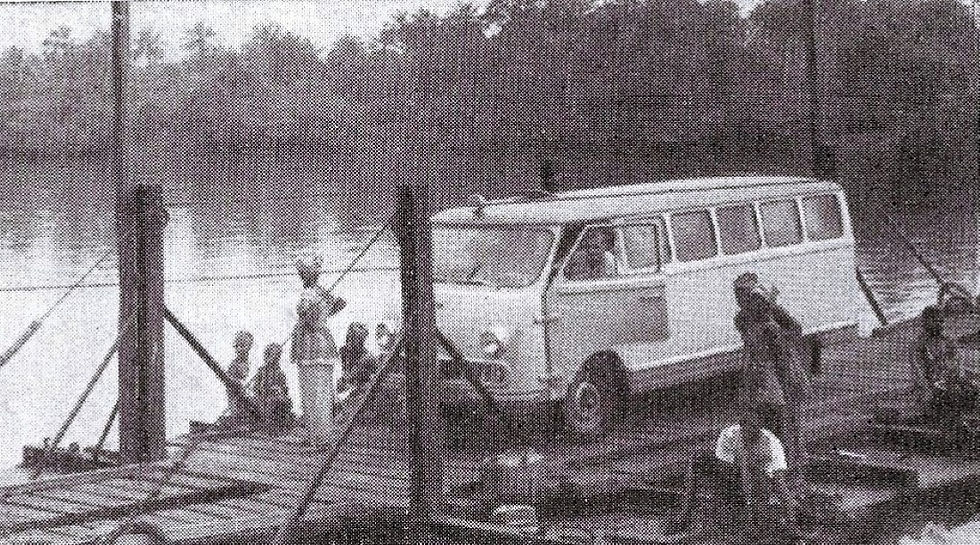
A Latvija minbus on a ferry in Ghana, c. 1970
RAF "Latvija" minibuses were an essential part of the Soviet transportation system. They operated as marshrutkas (fixed-route minibuses), were widely used by state enterprises, healthcare institutions, and specialized service agencies. Except for rare exceptions such as large families, private ownership of them was prohibited. Their versatility extended from medical services and police duties to passenger transport, making them one of the most recognized Soviet minibuses of their era

An RAF-2907 adopted for use at the 1980 Summer Olympics -- Pudelek (Marcin Szala), CC BY-SA 3.0, via Wikimedia Commons
Following Perestroika and the counterrevolution in the USSR, RAF faced a deterioration of supply chains, quality control issues, and market competition from both Western and Russian manufacturers. Attempts to modernize with new models did not succeed, and the last RAF minibuses were produced in 1997. The factory went bankrupt in 1998, with only a charter airline division surviving. Today, surviving RAF vans are considered nostalgic collectibles, with several models exhibited in the Riga Motor Museum among other places.
Key Soviet Models:
RAF-251 – GAZ-51 based bus (1955–1958)
RAF-977 "Latvija" – 10-passenger minibus (1959–1976), multiple variants including ambulances and cargo vans
RAF-2203 "Latvija" – Main Jelgava production model (1976–1997), used as passenger, ambulances, police, mail vans, and other specialized versions

The first version of the RAF 977 Latvija had a split screen.


Comments