


"The path is difficult, the situation is complex, but our will to overcome is unwavering": Miguel Mario Díaz-Canel Bermúdez

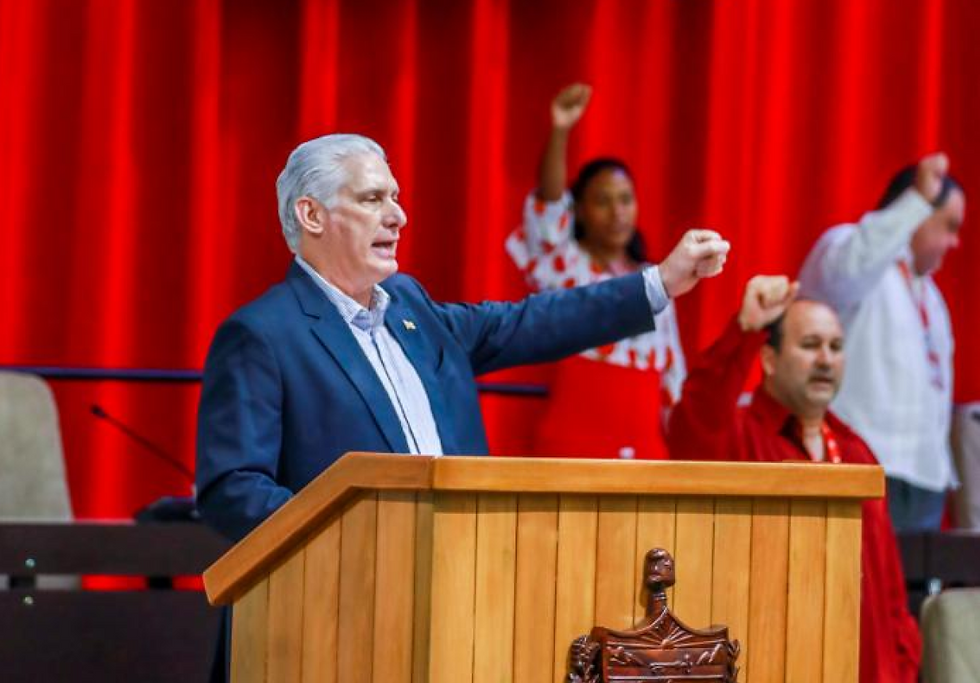
Image via the PCC
Speech delivered by Miguel Mario Díaz-Canel Bermúdez, First Secretary of the Central Committee of the Communist Party of Cuba and President of the Republic, at the closing of the Seventh Ordinary Session of the National Assembly of People's Power in its Tenth Legislature, at the Convention Palace, on July 30, 2026, “Year of the Centenary of Commander-in-Chief Fidel Castro Ruz.” (Translated from the Spanish)
Dear Army General Raúl Castro Ruz, leader of the Cuban Revolution;
Dear Deputies:
I wish to begin my remarks, today, Martyrs' Day, with the Assembly's well-deserved tribute to Commander of the Revolution Ramiro Valdés Menéndez, deputy of this Legislature and of all previous ones since the founding of Parliament in 1976.
Ramiro, a symbol of the Centennial Generation, is one of the paradigms of the Revolution, alongside Fidel, Raúl, Che, Almeida, Guillermo, and others too numerous to list endlessly. They are all exemplars of an invaluable legacy of ethical, moral, and patriotic values and qualities that demand our full attention in such crucial moments for our nation.
Like his brothers of that historic generation, which we are honored to continue, Ramiro leaves us an extraordinary legacy: dedicated body and soul to the great work he helped found, working and fighting until his last breath. He confirms that for a revolutionary there is no rest, neither in action nor in the dreams that inspire it. An example of humility, he embodies that Martí-inspired idea, so embraced by Fidel, that “all the glory of the world fits in a grain of corn.” He fostered unity around the Party, always practiced unwavering firmness in the face of imperialism, and embraced Che's great warning that imperialism cannot be trusted, not even a little.
I don't speak of Ramiro in the past tense, because there is no possible farewell to him. I evoke his example among us, servants of the people and defenders of the Revolution, to emphasize the significance of his work, but above all for the inspiration he leaves us in the face of today's colossal challenges.
Comrades:
The months between the previous Ordinary Session in December 2025 and the one we are now concluding have been marked by an extremely complex and threatening scenario, like that of a besieged fortress.
Since the treacherous military aggression against Venezuela and the kidnapping of its legitimate President on January 3 of this year, the concept of a world based on laws is being completely erased, threatening to transform the planet into a far more anarchic and insecure place than it already was as a consequence of the ferocious advance of neoliberal capitalism.
The neo-fascist regime currently in power in the United States is shamelessly repeating some of the horrors unleashed by German fascism in its expansionist zeal during the first half of the 20th century.
The points of convergence between these two regimes are becoming increasingly alarmingly dangerous for the fate of humanity and world peace.
Xenophobia, nationalist exceptionalism, lies as a tool of domination, the cult of personality, the proscription of opposing ideologies, the suppression of cultures, the conquest of territories and the plundering of their natural resources, and the collective punishment of large populations do not distinguish between, but rather increasingly link, Hitlerian fascism with which it is showing signs of reemerging.
Let us not forget that a part of the world looked the other way when the horrors of the genocide in Gaza were unleashed, and history will record the impunity and cruelty with which this people are still being massacred and their culture is being targeted for extinction.
United Nations agencies estimate that between 75,000 and 90,000 inhabitants of the Gaza Strip lost their lives as a result of the war. Around 60% of the victims are innocent women and children, in addition to the more than 10,000 missing under the rubble of bombed buildings.
Not content with their depravity, the perpetrators of this crime have caused the displacement of nearly 2 million people to a small strip of land, approximately 35 to 40 square kilometers in size. This has raised the population density to extreme levels of 30,000 to 40,000 people per square kilometer, an unsustainable situation in terms of shelter, water, sanitation, and healthcare.
It is crucial and urgent to recognize the gravity of these events: any of our nations could become Gaza again.
While this genocide has not entirely ceased, there is an attempt to repeat it against more than 9 million Cubans through an economic blockade and an energy embargo, which have brought the suffering of the Cuban people to extreme levels, practically incompatible with the basic needs of modern life.
The cynical and deceitful architects of this criminal policy deny the existence of the energy blockade. They don't mention the Executive Order signed by the US President on January 29, 2026, in which he threatens to penalize any nation that supplies fuel to Cuba.
This action is part of the US government's demonstrated ability to subdue the will of sovereign states through coercion and intimidation using trade tariffs, forcing virtually all countries to participate, voluntarily or involuntarily, in the economic blockade against Cuba.
Because of this arbitrary measure, Cuba has received only one fuel shipment in the last seven months.
The economic and social implications of this collective punishment are unbearable.
The blockade on the entry of diesel or fuel oil has prevented the National Electric System from having approximately 1,400 megawatts available daily for distributed generation, which in previous months had received significant investment for its recovery and optimization.
While it's true that these capabilities wouldn't have completely eliminated the current, extremely troublesome blackouts, it's obvious that their duration would have been significantly reduced.
The electrical disruptions to Cuban homes, a consequence of the oil embargo, bring other major problems to Cuban families, such as the shutdown of water pumping, prolonging the supply cycles of this essential resource.
Faced with the lack of fuel and lubricants, we have seen agricultural harvests and planting for the coming months severely impacted. Most industrial production processes have also come to a standstill.
Tourism, the most dynamic generator of fresh income, is seriously affected by the persecution of international markets, the lack of fuel for international aviation, and the threats against hotel companies operating in Cuba.
The healthcare system, its intensive care units, and the increasingly limited surgical procedures are under the constant threat of blackouts that endanger patients' lives.
To all this must be added the weeks and months of waiting in international ports for thousands of containers with medical supplies, food, photovoltaic equipment, parts and materials to resolve problems at power plants, among other resources essential for sustaining the country's vitality. All of this is due to the threats against shipping companies, the same companies that transport imports for the private sector, such as raw materials or basic necessities that are sold directly in the domestic market.
I have only mentioned some of the effects on the economy and society of this fascist blockade, which leaves no doubt about the perversity and contempt with which the United States treats the Cuban people, with the extreme cruelty with which it attempts to subdue and use them in its purpose of overthrowing the Revolution.
Cuban medical collaboration is being persecuted, based on repugnant falsehoods, to cut off an important source of funding that sustained the public, free, and universal healthcare system, and the effects of these measures are becoming increasingly acute with the lack of supplies and resources essential for this vital Cuban sector.
But the imperialists are not satisfied with the energy blockade, nor with cutting off our legitimate sources of financial income as much as possible; they also persecute, attack, and coerce any form of investment and foreign trade.
The Executive Order of May 1, 2026, threatens foreign individuals and companies, regardless of their country of origin, with secondary sanctions on their personal accounts, U.S. visas, and other consequences if they maintain any type of commercial ties with Cuba.
We are witnessing the most extensive and profound expression of a ruthless effort by the world's greatest power to disconnect the economy of a small island nation from the global economy.
While this genocide against the Cuban people is underway, its perpetrators brazenly lie to the world, denying their crimes.
They lie with such audacity that they are not even capable of justifying or convincing representatives of that nation in the federal Congress of their lies. These days, the honest concerns of some members of Congress who refuse to be complicit in the crime and who question the blockade and the threats of aggression against Cuba with a decorum so lacking in the would-be Führers of the current administration have gone viral on social media.
The admirable stance of these legislators, as well as that of The People’s Forum, Pastors for Peace, Code Pink, and other U.S. organizations that have stood in solidarity with Cuba for decades, remind us of the moving reflections that the support of the noblest of the American people always provoked in Fidel. Knowing the truth, the American people will undoubtedly be on the right side.
The blockade, according to our calculations and those of international organizations, has cost Cuba a cumulative total of more than 150 billion dollars. This is not an abstract figure; it is reflected in every aspect of our daily lives.
The special session of the United Nations General Assembly, held on July 7, demonstrated the widespread condemnation of this aggressive policy by the international community. The US attempt to prevent the debate was overwhelmingly rejected with a vote of 136 to 9.
And to the same extent that the empire lies and manipulates, it boasts of its aid to the Cuban people. There can be no greater cynicism and wickedness than depriving a people of the satisfaction of their most basic needs, and then boasting of aid that in no way covers the enormous daily cost of the genocidal siege of the island.
Can anyone truly believe that this plan of collective suffocation is merely a surgical strike against the government and its leaders? The facts clearly demonstrate that its objectives are to provoke social unrest, divide, and strike at the very core of the Cuban people.
As historians and analysts have commented, the United States' plan against Cuba is only comparable, in its objectives and perversity, to Weyler's reconcentration policy, which decimated the Cuban population through starvation. We come from that history, and from the will to win as well!
Fellow citizens:
Given the complex scenario I have described, how can we persist in building socialism? How can we find the material and financial resources to maintain the social gains of the Revolution? Just as in previous, particularly complex periods, such as the Special Period, when, under the leadership of the Commander-in-Chief and later the General of the Army, the economic model was transformed to adapt to challenging external circumstances, in the current context we have set out to undertake the transformations that the moment demands, under the leadership of the Party, in a collegial and democratic manner, in consultation with the people, without compromising independence, national sovereignty, or the social gains of the Revolution.
The 176 measures approved for Economic and Social Transformation are entirely consistent with the Guidelines for Economic and Social Policy approved in 2011 at the Sixth Party Congress.
Furthermore, they reflect the popular opinion gathered in the thousands of assemblies held throughout the country when the Government Program, already approved by this Parliament in December, was submitted for consultation at the end of 2025.
In the days following its approval, we have been attentive to public opinion regarding these measures and have shared spaces for discussion with several colleagues from different institutions. Therefore, we are aware that there are legitimate and frank concerns about the limits on the growth of private capital, the concentration of wealth and capital in the hands of a single individual, issues related to surface rights, usufruct and real estate transactions, the possibility of privatizing state-owned enterprises, the widening and normalization of inequality, the elimination of subsidies for services highly sensitive to the population, transparency in asset bidding processes, the role of the market, the potential ideological impact of capitalist relations, and the lack of mechanisms for popular participation and oversight to combat negative effects and corruption. All of these issues require close attention to avoid distortions.
The transformations we are implementing today are not for more capitalism, but to defend and advance socialist construction; a socialism that places human beings at the center of its work.
Popular participation and control are not relegated to the past, but constitute a permanent line of work and cannot remain merely a slogan. In the immediate future, we will engage in a process of discussion within the Party structures with the workers to argue, clarify, convene, contribute, optimize, and make corrections as we go, in real time.
The effective implementation of these transformations is a strategic priority for the nation, and we must all understand it as such, with a sense of national responsibility. They entail changes that are not without risks, but accepting a challenge is the first condition for overcoming it.
Implementing them requires a gradual approach, learning, and an awareness that something may not go well from the outset, but everything will be resolved if we are driven by a constant willingness to rectify, modify, and adjust everything necessary, immediately and without bureaucratization.
At this point, I want to acknowledge the thorough and efficient work of the various groups involved, both in developing the content of the reforms and their legislative underpinnings. Thanks to their efforts, we can now say that 120 of these reforms are ready for implementation.
We have prioritized those that promote the liberation of productive forces, those that strengthen the state and non-state business system as a whole within our Economic and Social Model, fostering harmonious relationships among its members, and those that facilitate the autonomy of municipalities and socialist state enterprises.
If we work well, we can immediately reactivate a range of production and service sectors that directly benefit the people, with a greater supply and a better relationship between wages and prices, as well as increase exports and the much-needed foreign exchange earnings.
To achieve this, we will promote incentives for investment, economic partnerships between the state, private, and cooperative sectors, and alliances that allow us to leverage currently underutilized capacities and potential.
This is a collective effort aimed at achieving greater social protection, and this demands maximum discipline with maximum efficiency.
This Assembly has taken a fundamental step by approving five legal regulations that support more than twenty ongoing transformations. The approval and immediate implementation of these regulations responds to the principle of building everything with legal certainty, as a guarantee for those who undertake these processes. This is a phase in which we cannot stagnate and in which we must continue to move forward.
Many will ask themselves in the neighborhood, in the queue, in the fields, in the workshops: what do these regulations offer in the face of the shortages we face? The answer is clear: they are the legal shield for the daily heroism of our people. They are not cold, impersonal rules; they are the engine of the transformations necessary for prosperity. They are the instrument that transforms creative resistance into tangible victory, protecting hard-won rights while we forge new paths toward the future.
They represent the necessary balance to preserve the social achievements that define us as a Revolution, while opening spaces for the initiative and creativity that the Cuban economy needs to thrive. Ultimately, it is what Fidel called “changing everything that needs to be changed.” All this legislative effort would be meaningless without the daily heroism of the people to whom we belong.
As we have already stated, and I want to reiterate categorically once again: these transformations are not being adopted to appease the United States, nor do they respond to any demands stemming from the limited dialogue process we have conducted during this period. They are the fruit of a sovereign decision by Cuba.
For its implementation, it is crucial to develop the concept of genuine People's Power, which implies accountability, community action to solve problems, transparency, participatory budgeting, broad worker management in their workplaces, popular oversight, spaces for public debate, the integration of all economic actors in local and territorial development strategies, and the dissemination of best practices in community work.
It will not be enough to have a general directorate at the central level, nor coordination at the provincial level. The determining factor will be achieving effective operational implementation at the territorial and community levels.
I want to emphasize the importance of decentralizing economic powers granted to the provinces, but particularly to the municipalities. No one should expect a magic solution from the outside. Everything depends, first and foremost, and increasingly so, on ourselves, on our own efforts, and on all those who wish to join us.
We must break the inertia, overcome obstacles, change mindsets, eliminate sterile bureaucracy, and resolutely confront corruption as quickly as possible.
I repeat, economic and social recovery must go hand in hand. To be clearer, the gradual economic recovery must lead us, to the same degree, to social recovery, prioritizing the most vulnerable and those sectors with the greatest needs.
In other words, economic efficiency must serve social justice, which encapsulates much of the meaning of the Revolution and its commitment to the people.
We are not going to establish predatory capitalism or a massive privatization of national assets, as some fear. Nothing could be further from the purpose of these transformations.
There will be no privatization of health, education, science, culture, or strategic services for the nation, and this must be made perfectly clear. What exists is the political will to recover them all, to generate income and wealth to raise them to higher levels of quality, free of charge and universally accessible.
In this complex process of strategic importance for the nation, the vanguard role of the Communist Party of Cuba as the supreme leading force of society and the State will be decisive.
It demands updating and innovating everything related to the role of the Party, its members, and its activists in socialist state enterprises, private companies, and the community. It also requires stimulating and fostering spaces for continuous theoretical and practical debate on everyday problems and perfecting and updating the operational dynamics of mass and social organizations.
An increasingly high ethical standard is imperative for all of us who hold leadership positions, guiding every decision we make.
This Assembly is the representation of our heroic people. It is the institutionalized voice of a nation that does not kneel, does not bend, and does not surrender.
When Martí wrote that the homeland is humane or it is not, he wasn't asking for a state that governed over the people, but a state that governed from the people. This Assembly must be the materialization of that dream; it is, and it will continue to be so.
I take this opportunity to highlight experiences we have observed during our visits and exchanges in communities, municipalities, and provinces over these past months and weeks.
In the complex energy landscape we are experiencing, the number of state and private entities incorporating renewable energy sources into their processes has increased, and many have even provided services to the population.
Progress is being made at the local level so that the main economic and social objectives operate using renewable energy sources, based on a national government program, but also with the participation and contributions of different management structures.
In the water supply, so difficult these days, recognition must be given to state-owned and private companies that have made their resources available to various communities for water transportation, in addition to initiatives involving the creation of new reservoirs. Similar efforts are being implemented, albeit on a limited scale, in solid waste collection in several communities.
Regarding another particularly complex issue, the availability of cash, which primarily affects the payment of workers and, most critically, retirees, solutions are being pursued with the participation of state entities using their additional funds and non-state entities that have offered their support in this endeavor.
I also want to highlight the improved situation of the Family Support System, thanks to structural renovations and improvements in its food service for the most vulnerable, in which various economic actors have also been involved.
The support for the more than 32 social programs aimed at assisting vulnerable individuals and families is having a positive impact, fostering a sense of collective solidarity at the community level, which we must acknowledge, encourage, and expand.
We have many areas of concern, which will persist until we alleviate the difficult conditions we are currently experiencing; however, there are also positive experiences that are contributing to our efforts and which we have a duty to share.
It is only right to recognize the intensity of the work carried out at the neighborhood and community council levels during these challenging months, with the direct participation of Party, State, and Government officials, members of the Revolutionary Armed Forces and the Ministry of the Interior, the Young Communist League, mass and social organizations, and business and administrative sectors, often working late into the night and early morning.
Members of Parliament:
The Revolution is under military threat from the fascist regime in the United States, which, as we have warned and maintain, would only bring terrible and unpredictable consequences for regional peace and an unnecessary cost in the lives of Cubans and Americans, something we never desire.
There is nothing, absolutely nothing, that justifies either the aggression or the threats. The plans against Cuba are based on false premises and fueled by the most blatant lies and manipulations.
With just as many, if not more, lies, they are trying to construct a pretext for military aggression against Cuba, based on the ridiculous and pathetic narrative that this small, underdeveloped island is a threat to the national security of the United States.
This is how the empire operates: it not only destroys, but also constructs the discursive apparatus to make the destruction seem deserved and inevitable.
Faced with this potential scenario, we will not remain impassive. We do not want a war with the United States; we are a people of peace.
The United States government is fully aware of Cuba's willingness to find solutions to bilateral differences through dialogue and to move toward a relationship of understanding based on respect for our sovereign rights.
In the Latin American and Caribbean region, a palpable political shift toward the extreme right is evident. The promising progress achieved in recent decades in defense of sovereign rights and in favor of regional integration and cooperation has given way to manifestations of subordination, under the pressure of U.S. imperialism, submission to the interests of a great power, and the predisposition of right-wing elitist governments that have surrendered to transnational capital, divorced from the needs of their people.
Even in this context, we have the support and solidarity of the Latin American and Caribbean peoples, and we enjoy fraternal relations with several governments in the region.
Over our hemisphere, and driven by reactionary and ultraconservative sectors in the United States, the old shadows of McCarthyism and the Cold War loom. The story is well known, however much some may try to conceal it. The human cost in repression, murder, disappearances, and shattered lives under the yoke of the fascist and oppressive dictatorships that flourished in the region during that period should serve as a lesson for new generations.
Recently, we have seen efforts to criminalize Cuba's genuine history of solidarity with just causes and peoples who aspire to a better world, as well as to target the open expressions of solidarity, friendship, and support for Cuba from all corners of the globe, including the United States.
The propaganda pamphlet published by the State Department declaring Cuba the capital of 21st-century communism is the latest attempt to rewrite history.
In the face of these new plans, we firmly reaffirm that nothing will divert us from our embraced commitment to solidarity, internationalism, and anti-imperialism (Applause). These principles are part of our identity, as is our dedication to building relations of friendship and cooperation with all countries and peoples.
Comrades;
Beloved people of Cuba:
The path is difficult, the situation is complex, but our will to overcome is unwavering. We are not a nation in dispute, nor a colony; we are a sovereign people who have decided our own destiny.
History has taught us that, in the darkest moments, when the empire tightens its grip and the difficulties seem insurmountable, the Cuban people find in their unity the strength to prevail.
This is what Fidel bequeathed to us: the conviction that there is no situation, however complicated it may seem, without a possible solution. And we find that solution when we unite intelligence with heart, when we work with dedication.
We are just a few days away from a date of profound significance for Cuban revolutionaries and revolutionaries worldwide: the Centenary of the Commander-in-Chief.
As I prepared these closing remarks for this session, which will necessarily prove historic if we manage to bring the ongoing transformations to fruition, I reflected on Fidel's extraordinary enduring presence. Ten years after his death, he continues to call upon us, to challenge us, to urge us to change everything that must be changed, by ourselves and through our own efforts.
But we already knew that. What is truly significant is the way in which his enemies, those who orchestrated more assassination attempts against Fidel than against any other world leader, continue to point to the Commander-in-Chief as the guide of the global left—the very left they claim no longer exists.
In this, the imperialist gentlemen are not mistaken. Fidel's ideas are sprouting anew with surprising vitality among people of all generations, from all continents, and from the most diverse political schools of thought. Fidel is no longer just ours; he grows larger and multiplies.
Fidel lives and promises to continue fighting battles for a better world!
Long live Fidel and Raúl!
Eternal glory to the martyrs of the homeland!
Long live free Cuba!
Socialism or Death!
Homeland or Death!
We will win!
This work was translated and shared via a License CC-BY-NC


Comments