


600 activists from 33 countries meet in Havana in solidarity with Cuba

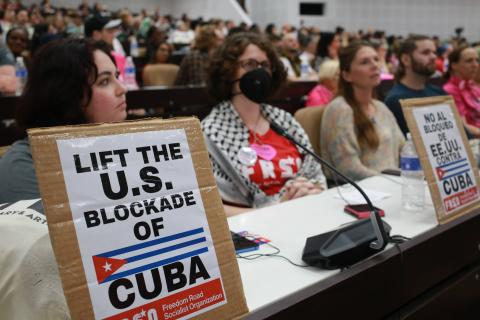
More than 600 activists from 33 countries met in Havana with President Díaz-Canel to reaffirm their support for the island in the face of the tightening of the U.S. blockade and threats from Donald Trump. The Nuestra América Convoy brought humanitarian aid and a unanimous message: international solidarity with Cuba transcends words.

Image via the PCC
By Katherin Hormigó Rubio, translated from the Spanish
Solidarity has consistently been a foundational element of the Cuban Revolution since it began. We can see an example of this in the various phases of our revolutionary journey, with countless grateful individuals worldwide who have the lone star etched in their hearts, having experienced the advantages provided by our professionals.
On March 20, in response to Donald Trump's threats to seize Cuba whenever he wants and to intensify the economic, commercial, and financial blockade against the Caribbean island, over 600 individuals from 33 countries arrived in Havana to express their solidarity.
At the Convention Center, a venue that has previously hosted similar exchanges, the members of the Nuestra América Convoy reiterated their message that "Cuba is not alone, nor will it ever be." This statement underscores the steadfast dedication of the activists, organizations, and political representatives who journeyed to Cuba to provide humanitarian aid.
The meeting was chaired by the First Secretary of the Central Committee of the Communist Party of Cuba and President of the Republic, Miguel Díaz-Canel Bermúdez, and other members of the top leadership of the Party, the State and the Government of the country.
Fernando González Llort, the president of the Cuban Institute of Friendship with the Peoples (ICAP), opened the speeches by describing the convoy as an historic event: "This convoy is making history for Cuba and the world. It confirms that united peoples are invincible," he stated.

The plenary session was filled with voices urging the end of the blockade against Cuba, including both familiar figures and newcomers visiting the island for the first time, yet who embrace the Cuban cause as their own.
Among those prominent voices were representatives from various countries. Fernando Pereira, from Uruguay's Broad Front, expressed gratitude for Cuba's longstanding solidarity and emphasized the importance of preserving "the soul" and the determination to uphold the truth, asserting that "today, Cuba represents our truth." Medea Benjamin, an American activist, stood among the numerous compatriots present—who made up the majority of the room—and denounced Washington's aggressive policies, including the blockade, which she characterizes as "genocidal" after over 60 years.
Michele Curto, the president of the Agency for Economic and Cultural Exchange with Cuba, is well aware of the significance of Cuba's solidarity with the Italian people. This gesture, during the Covid-19 pandemic, saved lives in both countries through medical collaboration in Italy and donations to Cuban hospitals. In his speech, he emphasized that "defending Cuba is defending the world we want," and warned that if any leader threatens to take the island, "we will gladly defend it."
"We are not here to tell you what you have to do, we have tremendous respect for you," said the Italian businessman, who also called for "pushing the European Union so that another shame does not occur like in Venezuela."
In his speech, Curto emphasized the core of genuine internationalism: to support without dominating, to coexist without force, and to honor without imposing conditions.
Ada Galano, a Cuban living in Italy, emotionally stated that "Cuba is receiving everything it has offered to the world" and reaffirmed her dedication to protecting the homeland "to the last dove of peace."
Gerardo Pisarello, a deputy in the Spanish Congress, highlighted the nobility of the Cuban people, while María Fernanda Carrascal, a representative in the Colombian Chamber, expressed gratitude to Cuba for its longstanding support for peace in her country and cautioned that the situation occurring with the island could happen in any country on the continent.
Mónica Valenti from the São Paulo Forum urged moving beyond slogans to implement tangible fundraising initiatives and provide material assistance. Claudia de la Cruz, another American, stated:"We know who the enemy is and how it acts, because we live on its soil."
Cuba continues to be a people of Homeland or Death!
"You are building bridges that no one can destroy," Díaz-Canel told the attendees, highlighting the purity of the flag of international solidarity. The president acknowledged the presence of old friends and, in particular, numerous young individuals, whom he referred to as protectors of the future and catalysts for change in a world characterized by conflicts and atrocities, like those experienced by the Palestinian people.
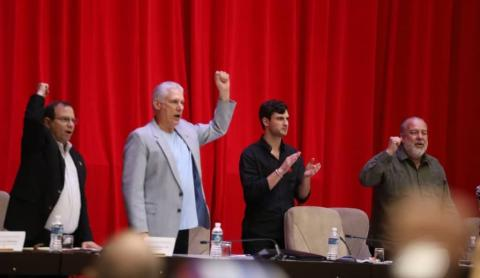
In his keynote speech, Diaz-Canel dismantled narratives about the illegitimacy of the Cuban Revolution, recalling that it overthrew a dictatorship and has had popular support for 67 years. He denounced the blockade as a significant violation of human rights, impacting the population daily, and dismissed the accusations of terrorism against Cuba, which has historically been a victim of such acts.
He emphasized that "the people support Cuba, and the governments that heed their people also support Cuba." Furthermore, the head of state highlighted that "those who stand with Cuba stand for all time."
"The example is what worries them," said the president, alluding to Cuban medical and educational cooperation with the world. He reaffirmed the unity of the revolutionary leadership and the willingness to defend the homeland "giving one's life if necessary."
The Cuban president noted that the participants have brought with the heart of solidarity. He expressed his endless gratitude for their support of the Cuban people and remarked, "When a nation fights with dignity, other nations stand by its side."
The Nuestra América Convoy, which has collected tons of humanitarian aid, stands as a concrete response to the growing pressures against the island, demonstrating that international solidarity transcends words and materializes in deeds.

With flags representing all continents and a variety of faces, including dozens of young Americans, the Convention Center transformed into a symbol of a shared reality: during decisive times, Cuba stands firm, supported by allied peoples that will not abandon it.
This work was translated and shared via a license CC-BY-NC


Comments