


An Army of New Doctors: The Barefoot Doctors of China, 1974

Part 1 of 2.

Preventive inoculations.
TLC Editor's Note: The barefoot doctor program emerged in response to a severe shortage of doctors in rural China, where most physicians were concentrated in urban areas. Before 1949 and the triumph of the Revolution, there were only about 40,000 doctors for a population of roughly 540 million, leaving rural communities vulnerable to diseases such as schistosomiasis. The program was formalized after Mao Zedong’s 1965 directive, which emphasized the need to address the urban bias in healthcare and provide medical services to the 80–90% of the population living in rural areas. The goal was to train one barefoot doctor for every 1,000 rural residents.
Barefoot doctors were typically farmers, folk healers, or recent middle and secondary school graduates who received three to six months of basic medical training in anatomy, bacteriology, disease diagnosis, acupuncture, Western medicine, birth control, and maternal and infant care. They continued to work in the fields while providing healthcare, reflecting the program’s integration into rural life. Their primary focus was preventive care, including hygiene education, immunizations, sanitation programs, and basic treatment for common illnesses. More complex cases were referred to township or county hospitals.
The barefoot doctor program dramatically improved rural health outcomes. It contributed to reducing infant mortality, eradicating smallpox, controlling tuberculosis and schistosomiasis, and increasing life expectancy from 35 in 1949 to 68 by 1979. The program also promoted family planning and basic hygiene, helping to modernize rural healthcare while remaining extremely cost-effective. By the 1970s, there were approximately 1 million barefoot doctors serving rural communities.
It is regarded as one of the great successes of the Great Proletarian Cultural Revolution.
Here we bring the first of two articles about these doctors from China Reconstructs Magazine in April 1974.
China Reconstructs Editor: There are now over a million peasant-doctors in China — people trained during the cultural revolution who continue their regular farm work but also serve the communes' brigade members as "barefoot doctors" (called this because the practice started in the south where they often work barefoot in the wet paddyfields). The "barefoot doctors" are a new and rapidly developing force in China's rural medical and health services.
Medical schools have trained a large number of doctors in the 25 years since liberation. But China is a developing country with a huge rural population (80 percent), and medical schools alone could not meet the need for doctors. Training thousands of "barefoot doctors" therefore became highly important to rapidly improving medical and health work in the countryside.
There is a great interest abroad in "barefoot doctors". Many of our readers ask, "What kind of doctors are they? How are they trained? What role do they play in China's medical and health work?"
The following two articles, about "barefoot doctors" in Yungfu county in the Kwang-si Chuang Autonomous Region [ the Kwang-si Chuang Autonomous Region is now known as Guangxi Zhuang Autonomous Region - ed. TLC] give some answers. On China's southern border, subtropical Kwangsi has 20,840,000 people of many nationalities. Before the liberation in 1949, health conditions here were terrible and disease rampant. Twenty-five years of Party led efforts, especially since the cultural revolution began, have created a medical and health network which protects the people's health. The region's 30,000 "barefoot doctors" and 150,000 production-team health workers play a key role in the prevention and treatment of disease in the countryside. Yungfu is one of Kwangsi's 82 counties.

An Army of New Doctors
By YU YANG
MOUNTAINOUS Yungfu county in north Kwangsi has 200,000 inhabitants of Chuang, Han, Yao and Hui nationalities. Unlike the past, even in the remotest village today no one worries about the lack of doctors. For, in addition to county and commune hospitals, every production brigade has its own clinic and "barefoot doctors", and each production team its health workers.
An Age-old Dream
Hot and humid, the county is prey to more diseases than usual. The inhabitants 1,300 years ago named it Yungfu (Everlasting Happiness), hoping they could change this dismal place into a paradise. On the face of a sheer diff in the western part of the county was carved a huge 5' X 4' character — "Longevity" — composed of 99 small identical characters in various styles. Countless worshippers through the centuries trekked here to pray for heavenly protection for a long life. Today it is only a reminder of the hopelessness of such prayers in the old society.
The "County of Everlasting Happiness" never saw happiness. Reactionary ruling class oppression and exploitation kept agriculture primitive and the people poor and disease-ridden. Frequent epidemics sometimes wiped out many lives. At the height of a cholera epidemic in 1946, people carrying the dead one day would often, themselves be carried to the grave the next. Even with light illnesses, people died because, without doctors, the disease dragged on until it became fatal. In many villages whole families died out from sickness.
The Dream Comes True
The Communist Party and the new people's government in 1949 put the protection of the people's health in the forefront. Yungfu county had only one clinic, four medical workers and four traditional drug stores left over from the old society. Within a few months, a county hospital was established. By 1958 the county had set up an epidemic prevention center and a mother and childcare center. The communes and brigades had also set up simple medical organizations.
But Liu Shao-chi's revisionist line was putting the stress on the cities and ignoring the countryside in public health. Under its disruptive influence the medical setups in the brigades were shut down and commune clinics became private clinics of a few doctors. Experienced doctors were concentrated in county and higher-level hospitals where they "specialized" in difficult cases. The rural areas, where the great majority of the people live, were going back to the old situation of few doctors and few medicines.
In June 1965, Chairman Mao issued a call to medical workers throughout the country: "In medical and health work, put the stress on the rural areas." This began the defeat of the revisionist line in public health and pointed out the right direction for China's medical and health work. As Chairman Mao's revolutionary line began to be carried out more effectively, a radical change took place in Yungfu county's health work.
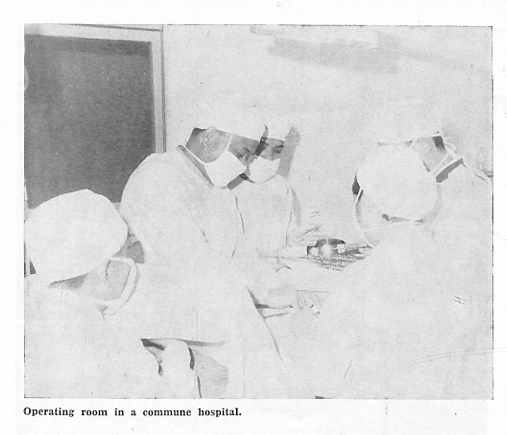
Today, in addition to the county hospital with 80 beds, each of the ten people's communes has its own hospital. Since 1965, the number of doctors in commune hospitals has grown from 58 to 190, and of beds from 24 to 155. All of them have X-ray machines, microscopes and surgical instruments as well as tablet-making machines. Each of the communes' 97 brigades has set up a cooperative medical care system* and its own clinic. There are 222 "barefoot doctors" (two or three in each brigade), instruments for treating ordinary injuries and 163 beds. Each of the 1,200 production teams has one or two health workers, and some teams have set up simple clinics stocked with common drugs. These first steps have oriented the county's medical and health network toward emphasis on the rural areas.
( *The cooperative medical care system in China is a mutual aid organization formed by members of the people's communes. In Yungfu county, a member pays about a half yuan Renminbi (now about British 9 p. or U.S. 25 cents) as annual dues. This, plus appropriations from the welfare fund of the production teams, enables each brigade to set up a clinic. A member pays 5 fen per visit and from nothing to 20 per cent of the cost, depending on the financial situation of his production team.)
Training
The army of "barefoot doctors" are the most active medical workers in this rural health network. Most of them are spirited youths from poor or lower-middle peasant families. Some are city school graduates who have settled in the countryside. A few are traditional physicians familiar with medicinal herbs. While their educational level is only primary or junior middle school, they have a high political level and a desire to rapidly improve the people's medical and health situation in the countryside.
Since 1965, the county has used different methods for training "barefoot doctors". One is 8-month to 2-year courses in which the students, chosen by the brigades, are taught by county hospital doctors. Studies include basic theoretical subjects such as anatomy, physiology, pathology, and knowledge of Chinese traditional medicine and medicinal herbs, common diseases and their causes, and the general fields of medicine and surgery. Close integration of theory and practice is the guiding principle, and classroom work is tied to clinical practice. The study of disease is linked to actual cases in the hospital. The students diagnose the case and then suggest treatment, the teacher pointing out the correct method and the reasons. When studying medicinal herbs, the teacher takes the class to the mountains to gather them and explains how to make up prescriptions. In the later part of the course, the teachers take the students to the countryside for practical training.
The county also runs an advanced eight-month course. This teaches basic medical theory more systematically and goes into the detailed how and why of difficult and emergency cases often met in their practice.
County and commune also arrange frequent one to six-month courses where "barefoot doctors" learn more about the prevention and treatment of the common diseases in the countryside, the use of medicinal herbs, acupuncture, etc.
"Barefoot doctors" in the brigade clinics call production-team health workers together several times a year for one-week sessions. Here they teach how to give injections, prevent seasonal infectious diseases, survey endemic diseases and treat minor illnesses and injuries with medicine, acupuncture and medicinal herbs.
The county and communes systematically call some "barefoot doctors" to their hospitals for internship or send doctors to the brigades to teach the "barefoot doctors" more.
Whatever method of training is used, the emphasis on political education helps the "barefoot doctors" strengthen their dedication to serving the people. With this motive, most of the county's 222 "barefoot doctors" rather quickly became skilled in general prevention and cure, and constantly improve through diligent study and practice. They handle practically all common diseases in the countryside with modern or traditional herbal medicine or acupuncture. Most of the women "barefoot doctors" know midwifery.

Prevention
Yungfu county's army of 222 "barefoot doctors" and 1,600 health workers has profoundly changed the life of the 180,000 peasants.
The "barefoot doctors" and health workers have actually become the mainstay in preventing disease in the rural areas. The workers at the epidemic prevention center know this, for although preventive work has been done every year since liberation, the speed, scope and result have never been as good as today. In the past, special groups had to be trained to travel from village to village giving inoculations or oral preventive medicine. Today, the "barefoot doctors" and health workers do it in their areas rapidly and thoroughly by going from door to door. In 1965 it took 35 days to vaccinate the county against smallpox. In 1973, it was finished in a week.
The "barefoot doctors" also play an important part in improving sanitation in the county and in surveying and treating such diseases as filariasis, hookworm and malaria. The incidence of these diseases has dropped sharply in recent years.
The "barefoot doctors" are also scouts in discovering possible epidemics. In the fall of 1971, "barefoot doctors" in the Tashih brigade of the Kuangfu commune treated several patients with a high fever and the symptoms of leptospirosis. They promptly reported this, the county epidemic prevention center verified it and the county and commune sent medical workers to give preventive medicine to everyone, disinfect the water in the fields and kill rats, the source of the disease. The epidemic was quickly checked.
Treatment
Though the ability of the "barefoot doctors" is limited, they play an important part in curing disease. A survey shows that from 1969 to 1972, "barefoot doctors" in brigade clinics handled 51 percent of all out-patient visits in the county. By 1973 it rose to 65 percent. This shows their importance to health care in the rural areas where 80 percent of the Chinese people live. Particularly for peasants in inaccessible mountain areas, the "barefoot doctors" are warmly appreciated like "fuel in snowy weather".
The 1,500 members of the Hsing lung brigade of the Lungchiang commune live in a rugged mountain area. Patients used to have to travel 20 kilometers over bad roads to reach the commune hospital. This took them away from work, increased their financial burden and sometimes caused death in emergency cases. In 1965, brigade member Li Chin-yu's first child came down with a high fever and convulsions. He died as he was being carried to the commune hospital.
The brigade set up a cooperative medical care system in 1969 and a clinic with three "barefoot doctors" and five beds. Last year Li Chin-yu's second child caught pneumonia. His temperature went up to 40° C., his lips became purple and he was close to death. At this critical moment, a "barefoot doctor" arrived, spent the whole night treating the child and saved him. Deeply moved, the parents said, "Our second child would have died too if Chairman Mao hadn't been concerned for us peasants and trained 'barefoot doctors' for the mountain areas."
Over the past five years, the "barefoot doctors" of this mountain brigade have treated 48,000 cases and admitted 540 to the clinic. They have done 370 minor surgical operations, including lancing abscesses and suturing wounds. They have cured over 200 serious cases such as high fever with convulsions in children, coma, pesticide poisoning, snakebite and massive bleeding from wounds. They continue to learn from veteran doctors in herbal medicine and herb-growers, collect effective home remedies, study China's medical heritage and put it to use. They use medicinal herbs in about half of their cases with good results.
Today the clinic refers no more than 20 patients a year to outside hospitals. All the health workers in the brigade's 14 production teams know how to treat common illnesses and injuries-with acupuncture and medicinal herbs. Minor cases are treated in the villages and ordinary cases in the clinic. For five years the peasants' attendance at work has been high and crops have increased year after year.
The changes in this mountain brigade reflect what has happened in the other 96 brigades in the county.


Comments