


Bangladesh’s Election: A Historic Test of Progressive Public Consciousness

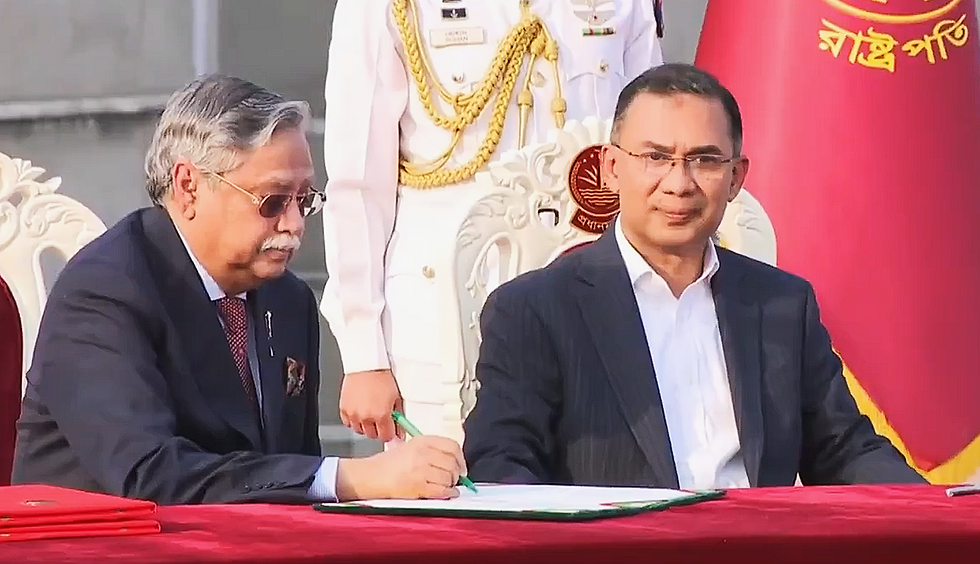
Tarique Rehman being sworn in as Bangladesh's new Prime Minister -- image via news video screenshot
By Muhammad Giasuddin
Bangladesh’s recent election was not merely a procedural transfer of state power; it represented a critical moment of testing for the nation’s social psychology, historical memory, and political orientation.
Before any political, scientific, or even social experiment reaches the vast arena of the public sphere, it must pass through complex processes—much like a laboratory procedure. Similarly, the political decisions of millions of citizens converged and took organized form in the public sphere. In this sense, the 2026 national election functioned as a grand political laboratory in which the people demonstrated a progressive and conscious political mind. From timely decision-making to fulfilling the essential electoral criteria, the electorate displayed notable political awareness.
Left-leaning progressives, feminists, environmentalists, cultural activists, and other forward-looking individuals all contributed to shaping this outcome.
Compared to several previous elections, this one was widely assessed as significantly fairer and more spontaneous—an evaluation that is not without basis. Although a voter turnout exceeding 70 percent would have provided greater reassurance to civic observers, the overall participation, eagerness to express opinions, and the electoral environment together signaled an active democratic practice.
One of the most significant features of this election was the visible and assertive participation of women in resistance to fundamentalist aggression.
From the Language Movement of 1952, the Education Movement of 1962, the Mass Uprising of 1969, the Liberation War of 1971, the anti-Ershad movement of 1990, the Shahbagh Movement of 2013 against fundamentalism, to the July Mass Uprising of 2024—women’s participation has consistently played a decisive role in shaping the character of the state. Their extensive and active engagement has functioned as a central element in determining Bangladesh’s political trajectory.
In this election, women took a firm stance at the ballot box against the anti-women attitudes of many political parties and the tendency to confine women to domestic spaces. Their position was not merely political; it also articulated a broader social resistance. At the same time, many observers believe that the constructive role of the armed forces contributed to maintaining stability in the electoral process.
Voters also conveyed a clear message: there can be no compromise on independent national identity. Public reaction was explicit against attempts to trivialize or metaphorically strike “below the belt” at the historical memory of 1971. Simultaneously, opposition to authoritarian, fundamentalist, and fascistic tendencies—along with enthusiasm for participatory, quasi-referendum-style engagement—reflected a politically conscious society.
Yet another reality emerged in this context. A segment of the population felt that to drive the final nail into the coffin of fundamentalism, an effective political alternative was required—one that was not immediately available.
As journalist Nurul Kabir of New Age observed, “the people leaned toward the Bangladesh Nationalist Party (BNP), even if they had to hold a handkerchief to their noses.”
Although the BNP has historically been identified as a bourgeois nationalist force, from its inception to the present moment it is being portrayed—by some—as playing its most progressive role yet.
Even if 80 percent of its parliamentary members are alleged loan defaulters, the party appears to be expressing a culture of commitment to democratic practice. Nevertheless, criticism regarding its long-standing relationship with international economic structures remains—particularly its alleged dependence on policies influenced by the World Bank, the World Trade Organization, and the International Monetary Fund.
Serious controversies also persist concerning corruption and militancy during its previous tenure in power. Yet in the post-Hasina political reality of 2026—amid fears of a drift toward extreme right-wing fundamentalism—a portion of the electorate appears to have adopted what they perceive as a comparatively progressive stance. At this juncture, the BNP has managed to politically channel that current, and some observers suggest that it is strategically positioning itself closer to left-leaning discourse.
However, this raises a larger question: does the absence of a well-organized leftist political bloc, alliance, or effective electoral front inevitably push the public toward reliance on a bourgeois party? If so, Bangladesh’s future political trajectory risks being confined within the limits of bourgeois nationalism, externally dependent economic structures, and a narrow spectrum of alternatives. Temporary relief cannot substitute for long-term political transformation—a reality that leftist forces and all conscious observers must keep in mind. This concern is not unfounded.
There is, however, room for hope. Left-progressive thought has not disappeared from either state institutions or the public sphere. The organized strength and conscious civic engagement of women remain crucial. If left-progressive parties, organizations, and political forces can function as effective pressure groups beyond the formal sphere of state power, a balance in policymaking may yet be achieved.
The vitality of democracy lies precisely here—in the active coexistence of plurality and critical participation.
In sum, this election marks an important turning point in Bangladesh’s political consciousness. It has shown that citizens do not merely cast votes; they make decisions about history, identity, security, and the direction of the future. Within those decisions lie possibility, contradiction, and the seeds of new political construction. Nevertheless, if lasting transformation of people’s lives is to occur, a stronger and more assertive role for leftist forces remains essential.
Muhammad Giasuddin is a writer and columnist based in Dhaka


Comments