


No Peace for Paz: Bolivian movements demand president resign

Demonstrators have closed several roads and faced heavy repression from security forces. Meanwhile, the Paz government has accused former president Evo Morales of being behind the mass protests.
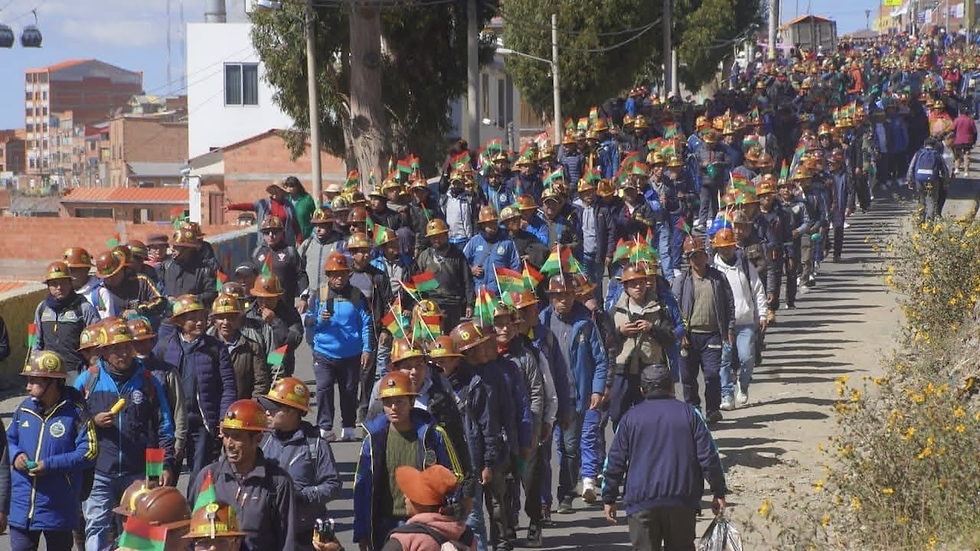
Bolivian workers with COB march towards La Paz. Photo: COB
By Pablo Meriguet, People's Dispatch
The protests in Bolivia against Rodrigo Paz’s neoliberal government continue to intensify. The main roads leading into and out of La Paz and El Alto remain closed following violent clashes between protesters and state forces on May 16. Over 50 people have been arrested, and dozens been injured. The roadblocks have triggered a genuine and critical political and economic crisis in Bolivia.
Initially, the first protests were launched by groups of farmers who opposed the controversial Law 1720, considered one of the most significant agricultural reforms in Bolivian history. The law, aligned with the neoliberal interests of Paz and his political and economic group, sought to convert land into a financial asset for granting loans, which would eliminate the iconic exemption from seizure that governs agricultural property in Bolivia – that is, the principle that it is impossible to take land away from a small or medium-sized farmer.
Various sectors of farmers rejected the law because they consider it a form of land commodification. In response, on March 26, farmers, indigenous people, and Amazonian landowners, among others, undertook a march of more than 1,000 kilometers to La Paz as a sign of rejection of the ruling party’s decision, which forced the government to quickly repeal the reform, although the Chamber of Deputies has stated that it will draft another law that reflects the same spirit as the previous one.
In response to the farmers’ mobilization, other sectors decided to join the protest and present their own demands to a government that, they claim, is more interested in appealing to specific national and international economic groups (such as agro-industrial companies and large international corporations interested in appropriating economic resources like natural gas, mining, and lithium, among others, by dispossessing the poorest of their land) than in resolving the difficult situation of the Bolivian people. Thus, teachers demanded wage increases in the face of inflation; transport workers demanded a resolution to the fuel shortage; and miners demanded labor reforms.
The demonstration quickly grew to massive proportions as more groups joined the protests, collectively voicing demands regarding the country’s difficult economic situation, the high cost of living, and an economy that – despite the executive branch’s initial promises – has failed to improve under the proposed neoliberal reforms. The pro-sovereignty demand to keep natural resources under Bolivian control and not hand them over to domestic and international private interests has also resurfaced with force.
The government’s response to the growing popular mobilization
In the face of a protest that has rapidly grown in scale and demands, the government deployed a large number of police and military personnel to repress protesters and clear them from the roads. The move has led to further clashes and a more confrontational stance on both sides.
The government has also accused former president Evo Morales of somehow orchestrating the protests as part of his own broader plan aimed at overthrowing the Paz administration. José Luis Gálvez, spokesperson for the presidency: “The protesters’ demands have been largely addressed in line with reality, but dark forces are seeking to destabilize democracy.” Gálvez also made references to political leaders from “Chapare” being involved, which is where Morales is from.
Morales rejected the government’s stance while expressing support for the demonstrations and the protesters’ right to protest: “There are no ‘sinister plans.’ There is a country tired of being lied to. Because the government protects business owners, bankers, and agribusinesses, while people are once again standing in lines, going into debt, and going hungry. And no speech is going to erase that reality.”
This is the second wave of mass protests that the Paz administration has faced in less than a year since taking office. In January 2026, the country’s major unions, along with students, teachers, farmers, social movements, and others, protested against the right-wing government’s plan to eliminate fuel subsidies – a measure that Paz was forced to abandon following overwhelming public opposition shortly after taking office.
What is behind this new wave of protests?
The Paz administration was seemingly weakened by its defeat in January. Despite its attempts to call on the right to unite, the administration has failed to gain new support. Its governing style – which is more aligned with very narrow national and international interests and displays an evidently anti-labor stance – has undermined its chances of recovery.
This was evident when, in the regional elections last April, Paz and his allies suffered a clear defeat. Both the right-wing and left-wing opposition managed to secure significant regional victories, which once again highlighted the weakness of a government that seems to rely more on the support of the Trump administration and right-wing governments in the region than on solid domestic legitimacy. Paz managed to win only two out of nine governorships.
In light of this situation, since May, various sectors – including workers, farmers, teachers, Indigenous people, transport workers, and students – have intensified their opposition to the current government on the streets and have raised a series of demands, such as wage increases, stabilization of an economy that shows no signs of relief under neoliberal measures, and opposition to the privatization of public enterprises.
Following harshly repressed demonstrations and a confrontational stance by the executive branch, protesters have begun to demand, with increasing intensity, the resignation of Rodrigo Paz from the presidency of Bolivia.
The Bolivian Workers’ Center (COB), one of the most important labor unions in the region, is currently demanding that Paz step down as president. The “Tupac Catari” Single Workers’ Federation is also insisting on this demand; they have carried out several roadblockades in support of farmers in the Amazon region, who are also calling for Paz to step aside.
In addition to the groups currently involved in the conflict, supporters of former President Evo Morales have announced that they will arrive in La Paz to join the protests starting on Monday, May 18. The Bolivian prosecutor’s office has issued an arrest warrant for the former president, who denies the charges against him and claims that this is a “lawfare” ploy to destroy his reputation and imprison him.
In addition, Morales denounced an alleged plot to assassinate him, which has sparked a wave of outrage among his supporters. According to the former president, “US Marines and Paraguayan DEA agents” are planning to attempt to take his life and that of several residents of the tropics, where Morales currently resides and is protected by the local population.
Way out for Paz?
Some analysts have pointed out that the Paz administration will have to build bridges of dialogue with various sectors that are demanding his resignation. For now, he has attempted to reach out to several opposition groups to ease tensions and negotiate on certain issues following the withdrawal of law enforcement forces, which were forced to retreat in the face of fierce resistance from protesters.
Following failed attempts to clear roads that have further polarized Bolivian society, the Paz administration called for dialogue with the various protest groups to reopen the roads in El Alto, where some of the most significant clashes of recent days have taken place. Government spokesperson Gálvez stated: “All of this is aimed at initiating talks, a productive dialogue, to identify the various needs in the city of El Alto and develop a work plan.”
In addition to these attempts to establish some legitimacy, Paz has received clear support from the United States. According to Washington, which has declared its support for the Paz government, the blockades have created a “humanitarian crisis.”
This was announced by the Bureau of Western Hemisphere Affairs of the US Department of State, which condemned the protests and declared its support for the Bolivian government: “In Bolivia, riots and blockades have created a humanitarian crisis, causing shortages of medicine, food, and fuel. We condemn all actions aimed at destabilizing the democratically elected government of Rodrigo Paz and support it in its efforts to restore order for the peace, security, and stability of the Bolivian people.”
Washington’s right-wing allies have also declared their support for Paz in light of the radicalization of the protests. The governments of Ecuador, Argentina, Chile, Costa Rica, Guatemala, Panama, Paraguay, and Peru issued a joint statement on May 15 backing Paz and condemning the roadblocks as well as the popular protests.
“We express our concern over the humanitarian situation in Bolivia, resulting from the protests and roadblocks that have led to shortages of food and supplies for the population… We reject any action aimed at destabilizing the democratic order and undermining the government’s institutions… We reiterate our solidarity with the [Paz] government and urge all political and social actors to resolve their differences through dialogue,” the joint statement reads.
For his part, Colombian President Gustavo Petro stated that Bolivia is experiencing a genuine “popular uprising.” He also offered to mediate the conflict: “My government is willing, if invited, to seek peaceful solutions to the Bolivian political crisis… There should be no political prisoners anywhere in the Americas; we must build a deep, multicolored democracy in our civilization.”
Thus, Bolivia is facing critical moments that will define its political and economic future. While the government seeks to weather this storm, it appears that a segment of the opposition is determined to see the struggle through to its final stages, which for now presents an unpredictable scenario in one of the Latin American countries with the strongest tradition of social mobilization in 21st-century Latin America.
This work is the property of Peoples Dispatch and is shared under a Creative Commons Attribution-ShareAlike 4.0 (CC BY-SA) license.


Comments