


Swiss Communists on minimum wages, student exploitation


Images via the Communist Party (Switzerland)
The Swiss Parliament has recently approved the Ettlin motion, which grants generally binding Collective Labour Agreements (CLA) precedence over cantonal minimum wages. The Communist Party strongly opposes this reform and therefore supports the referendum launched by the Swiss Trade Union Federation, calling on to sign it.
This reform is not only yet another attack by the bourgeois parties and employers on workers' rights, but also an attack on federalism and popular sovereignty. It was the citizens themselves who voted to introduce minimum wages at the cantonal level. In the cantons of Ticino, Geneva and Neuchâtel, minimum wages were democratically approved, yet the Swiss Confederation now seeks to deprive both the people and the cantonal parliaments of the possibility of establishing, at least within their respective territories, minimum protections against exploitation, wage dumping and the replacement of local labour.
It is worth stressing that this amounts even to an attack on the rule of law. Collective Labour Agreements are private-law contracts negotiated between trade unions and employers' organisations. The reform just approved in Bern therefore allows an agreement concluded between private associations to override a democratically enacted law of the State. In short, this creates a potentially dangerous precedent whereby private actors may in the future circumvent any other legislation serving the public interest that they happen to dislike.
The Communist Party is fully aware of the current legal constraints in Switzerland, which prevent minimum wages from playing a genuinely redistributive role, limiting them instead to instruments of social policy aimed solely at combating poverty and the dramatic phenomenon of the 'working poor'. At the same time, the Communist Party also recognises their importance in preventing a race to the bottom and unhealthy competition among workers, while supporting the thousands of people who, despite being employed, are still unable to cover their living costs. Defending the minimum wage also means preventing society as a whole, through social assistance, from having to make up for the irresponsibility of those employers who pay poverty wages.
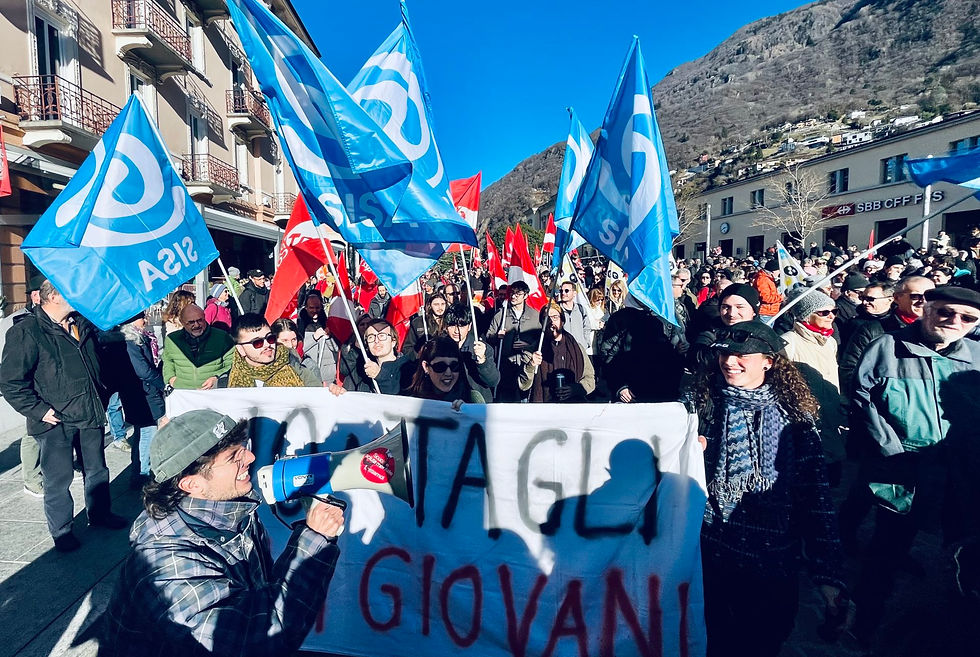
The Swiss Communist Youth - youth branch of the Communist Party (Switzerland) - whose members are actively involved on the front lines of the student movement - endorses the public statement issued by the Independent Students' and Apprentices' Union (SISA) regarding cases of exploitation affecting students engaged in summer jobs.
The statement rightly points out that the absence of a statutory minimum wage for underage young workers cannot serve as an excuse for employers to evade paying wages that are fair and commensurate with the work performed by students. Students are, in fact, the most vulnerable group: not only because the summer holidays are often the only period during which they can build a degree of financial independence, but also because they are among the first to suffer from cuts to public transport and education.
We find the testimonies of students employed in demanding sectors such as hospitality for wages as low as CHF 10.- per hour deeply shameful. Even more disgraceful, however, is that the situation is even worse within the public sector, where cases have been reported of wages falling to around CHF 6.- per hour for logistics and administrative work in healthcare facilities, government institutions, and other public bodies. The public sector should be setting an example for private employers, not engaging in even worse practices. The Swiss Communist Youth believe it is futile to rely on the goodwill and honesty of employers: what is needed is legal protection that safeguards young workers through binding legislation.
This is in fact one area where Swiss federalism makes a tangible difference. While the Canton of Ticino excludes underage workers from the scope of its Minimum Wage Law, the Canton of Geneva has adopted a more advanced approach by extending statutory minimum wage protection to this category of young workers as well. The Geneva model should be generalised across Switzerland in order to put an end to these shameful forms of exploitation, while safeguarding a balanced labour market and preventing unfair competition between young and adult workers.
For this reason, the Communist members of the Parliament of the Republic and Canton of Ticino, comrades Massimiliano Ay and Lea Ferrari, have promptly tabled a parliamentary initiative aimed at closing this legal and political loophole. The proposal seeks to ensure that students who work exclusively during school or university holidays are guaranteed a legally protected minimum wage.
Under the current Minimum Wage Act in the Canton of Ticino, statutory minimum wage protection does not apply to underage workers engaged in "light work", nor to apprentices, trainees, or interns. This exclusion leaves many young students in Ticino without even the most basic legal protection during so-called summer jobs, exposing them to derisory pay and outright exploitation.
The Communist Party has therefore proposed introducing a specific legal provision covering students enrolled in recognised educational institutions who work during school or university holidays. While taking into account their limited professional experience and the need not to discourage seasonal hiring, the proposal would nevertheless guarantee these students a protected minimum wage. The measure would apply exclusively to occasional employment for a maximum of 60 days per calendar year, thereby preventing this exception from being abused to replace permanent jobs with underpaid temporary labour. The initiative therefore proposes setting the applicable minimum wage at 75% of the ordinary statutory minimum wage.


Comments