


US Imperialism Exposed Again: The Ceasefire with Iran and the Myth of Invincible Power

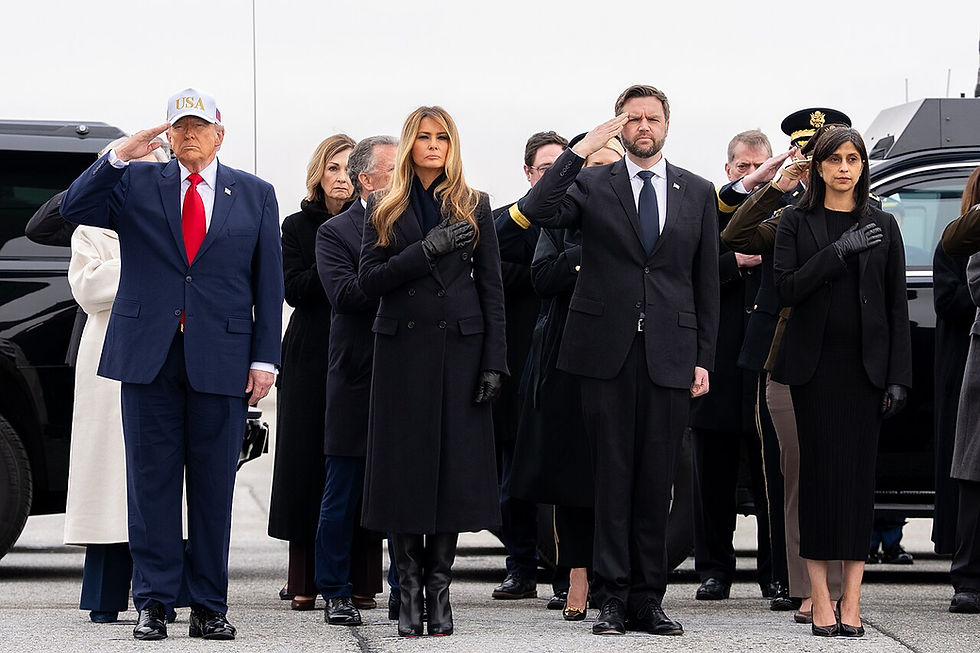
Trump and Vance at a ceremony for US soldiers killed in the war on Iran, March 7 -- public domain image
By Pallab Sengupta, Communist Party of India
The recent ceasefire between the United States and Iran is not a diplomatic breakthrough born of mutual respect. It is a strategic retreat forced upon Washington by the very real limits of its military power. After weeks of escalating threats, the movement of carrier strike groups, and explicit warnings of “devastating bombardment,” US imperialism was compelled to accept a two-week ceasefire with Tehran—narrowly avoiding a catastrophic war in West Asia.
The agreement was signed only hours before the US deadline for attacking Iran’s energy and military infrastructure. The promised “overwhelming victory” never came. Instead, the world witnessed a hurried climb-down. For anti-imperialist and progressive forces globally, this moment reaffirms a fundamental truth of revolutionary analysis: imperialism, for all its firepower, remains a paper tiger—dangerous, but fundamentally unable to translate military superiority into political domination.
The Contradictions of Imperialist Aggression
This crisis was manufactured by the US-Israeli military axis, which has long sought to cripple Iran’s sovereignty. Washington issued ultimatums, threatened to blockade the Strait of Hormuz, and massed military assets under the guise of “defence.” Yet, when confronted with Iran’s refusal to submit—backed by regional resistance networks and a clear diplomatic counter-offer—the United States blinked. Critically, Washington stood almost entirely alone. Even traditional NATO allies, wary of another catastrophic West Asian war and the economic fallout that would follow, showed no interest in supporting US military action. There was no "coalition of the willing"—no meaningful contingent of European or other major powers willing to lend legitimacy or firepower to an assault on Iran. The much-vaunted transatlantic alliance revealed itself, in this moment of decision, as a hollow shell when imperialist adventurism is no longer perceived to serve the interests of junior partners.
Why? Because imperialism’s core contradiction is now impossible to hide: it possesses enormous destructive capacity, but it cannot secure political victory against a determined nation-state with regional allies, independent infrastructure, and popular legitimacy—and it cannot even count on its own subordinate allies when the risks outweigh the rewards. Iran, battered by decades of sanctions and assassinations, entered negotiations from a position of refusal—not submission. It tabled a ten-point peace framework addressing sanctions relief and regional security, forcing Washington to talk rather than bomb.
The ceasefire is therefore not a sign of US strength. It is a sign of US weakness—a recognition that another West Asian war would accelerate imperial overstretch and trigger global energy shocks that even the Pentagon cannot control. Washington’s isolation among its own nominal allies only underscores the deeper truth: the age of unilateral US military intimidation is passing, and even the imperialist camp is no longer unified.
Diplomacy from the South: Pakistan Shows the Way
A critical political lesson from this episode is the role of independent regional diplomacy. Pakistan intervened directly, urging Washington to suspend military operations and facilitating back-channel talks between US and Iranian officials. The resulting two-week ceasefire and planned peace talks in Islamabad are a direct product of this initiative.
India’s Strategic Failure
In sharp contrast, India’s response to the crisis exposes a troubling trend in its foreign policy.
Traditionally, India upheld a principled commitment to non-alignment, peaceful coexistence, and support for anti-colonial struggles. During the Cold War and the decades that followed, New Delhi often played a constructive role in promoting dialogue and de-escalation in international conflicts.
However, the current government has increasingly abandoned this independent approach.
During the recent crisis, India largely limited itself to cautious statements welcoming the ceasefire and calling for stability in maritime routes such as the Strait of Hormuz.
While such statements are important, they fall far short of the proactive diplomacy expected from a country of India’s size and international standing.
More significantly, India’s growing strategic alignment with the United States and Israel has constrained its ability to act as an independent voice for peace in West Asia. Over the past decade, New Delhi has steadily deepened military, intelligence, and political ties with both Washington and Tel Aviv.
Such alignment has serious implications. Israel has been deeply involved in regional conflicts and is widely seen as a key partner of US imperial strategy in West Asia. When India positions itself too closely with this axis, it undermines its historic image as a supporter of Palestinian rights and a promoter of regional peace.
This shift not only damages India’s moral standing but also reduces its diplomatic space.
The recent US-Iran crisis illustrates this problem clearly. While Pakistan, China, and other regional actors attempted to facilitate dialogue, India remained largely on the sidelines.
War has temporary halted but crisis remain unsolved
The ceasefire between the United States and Iran has temporarily halted a dangerous escalation in West Asia. Yet the deeper contradictions that produced the crisis remain unresolved.
The episode once again demonstrates that imperialism, despite its formidable military power, cannot easily impose its will on sovereign nations. When confronted with determined resistance and international diplomatic pressure, it reveals its true nature as a “paper tiger.”
At the same time, the crisis highlights the urgent need for independent and peace-oriented foreign policies in the Global South. Countries that prioritise diplomacy and strategic autonomy can play a decisive role in preventing wars and promoting stability.
For India, the moment calls for serious reflection. Instead of drifting into the orbit of US-led geopolitical blocs, it must revive its historic commitment to non-alignment, anti-imperialism, and international peace.
Only through such a course can India reclaim its voice as a champion of global justice and a credible force for peace.


Comments