


An Ex Guerrilla Runs for the Senate

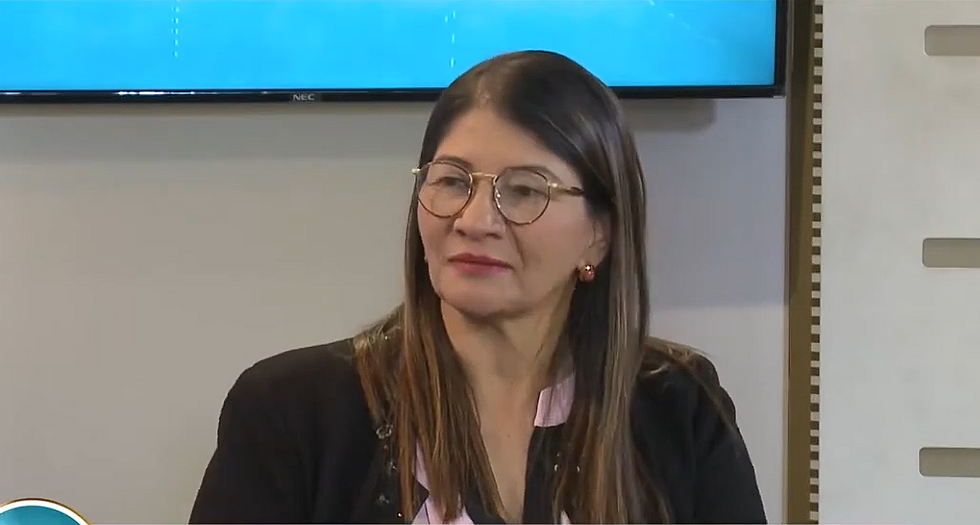
Griselda Lobo Silva -- image via news video interview screenshot
By Taroa Zuñiga Silva and Vijay Prashad
You must imagine what it must have been for Griselda Lobo Silva, who was born and raised in a farm in La Paz (Colombia), to have seen these young people walk through her land when she was a young girl. Her mother had fallen ill, and Griselda was the one who had to leave school to take her care of her seventeen brothers and sisters. The farm was modest and their lives were hard. But here came this band of rebels, armed and disciplined, with a leader who was a woman. Griselda watched them with fascination. They treated her brothers and sisters with care and did not steal from the farm despite being armed. Her fascination with these men and women only grew. At the age of sixteen, when other siblings could take up her work at home, Griselda joined these fighters who were part of the Revolutionary Armed Forces of Colombia (FARC). She took on the name of Sandra Ramírez and spent the next thirty-five years in combat to make her country a more equitable place, a better place.
In 2018, Sandra—the farm girl now an ex-combatant—took her place as one of the ten nominated Senators and members of Congress as part of the 2016 peace agreement. In the Senate, Sandra fought for the very things that she had spent her life fighting for in the forests. The agreement now comes to an end, and so Sandra —now a member of Comunes, a left-wing political party that emerged out of the guerrilla movement—is fighting to win back her seat to the Colombian Senate. We spoke to Sandra as she campaigned in the election that will take place on Sunday, March 8.
When the peace agreement was being negotiated in Havana (Cuba) from 2012, Sandra was sent by the FARC as one of their representatives. Out of the peace deal in 2016, Sandra said, “we brought the voice of reconciliation and truth.” Out of the agreement and with her seat in the legislature that came with that agreement, Sandra says that she managed “to be more active across the country, getting to know the problems that various communities face on a daily basis and to try and find solutions, together with the state institutions, to these immense problems, especially with relation to land.” However, Sandra points out sadly, since the agreement, over five hundred of her comrades who had signed the peace agreement have been murdered and other comrades have been evicted from territories due to the lack of security for them and their families. The media, which has been hostile to her campaign, has continued to stigmatize the ex-combatants who “in good faith” signed the peace agreement.
Once the former combatants entered the Congress, they found themselves surrounded by the right-wing. This configuration of the Congress, Sandra told us, put forward “no legislation in the interests of Colombian society.” Nevertheless, Sandra and her comrades “managed to make progress,” for example by fighting to get the peasantry recognized as subjects with constitutional rights. The fight for the peasantry, she told us, was about the need for agrarian courts in rural Colombia to solve the problem of land. The point of this fight was to resolve the problems of ownership and access to water. “Land was brutally taken from the peasants, and today has other owners and that has to be resolved in an agrarian court.” The Left in the legislature made very slow progress, although on other issues—such as on labor rights and pension reform—the advances came faster. There was progress on education and on health, but very little on infrastructure. Roads, she said, “are the blood vessels that connect to the arteries,” but since “we don’t have blood vessels, there is a great deficit that exists in the country.”
It is not enough to distribute land and call it agrarian reform. What is needed in Colombia, Sandra said, is “comprehensive rural reform, which means that the land is not bare but is connected to roads, to education, to health, to housing, and to credit.” We asked her about crop substitution from the growing of crops such as coca to other commodities. The Havana Agreement, which she helped to formulate, had as its first point comprehensive rural reform with sixteen plans that included not allowing the land to be bare. Without rural reform there can be no substitution of crops. The Left has been busy in the land that has been turned over to build cooperatives and to build solidarity unions—all to create a popular solidarity economy. There should not be forced substitution but only voluntary substitution, in other words, farmers must meet in assemblies and agree to the way forward and not be bombed to stop growing coca. All of this is fine, but she pointed out, “the international community must bear some responsibility with the demand for consumption.” The United States and Europe have tens of millions of drug users who drive the economic demand for the crops. “There needs to be an international conference on drug policy that takes into consideration all these aspects,” she said.
Underneath these issues has been the human rights violations during the long war for the land and for dignity. The state and its institutions, Sandra said, “have not been called to account. They have not been asked to acknowledge their responsibility for the Colombian conflict.” Since the government of President Gustavo Petro delayed the implementation of the Havana agreement, Sandra said, it has been difficult “to obtain statistics on the agreement’s progress.”
The election in Colombia is fundamentally important not only at the local level but at the presidential level. US President Donald Trump has tried to interfere in Colombia, but he faced resistance from Petro. A president of the right would welcome Trump’s interference. Sandra told us that her party defends the self-determination and autonomy of people. “Here in Colombia, we have decided to have a president with the human qualities of Gustavo Petro, and we recognise this at all times. We cannot tolerate a president who will give away our destiny.”
Taroa Zúñiga Silva is a writer and Spanish media coordinator for Globetrotter. She is the director of the publishing house La Trocha and a member of the Mecha cooperative, a project of the Liberation Communication Army. She is co-editor, along with Giordana García Sojo, of the book Venezuela, vortex of the 21st-century war (2020).
Vijay Prashad is an Indian historian and journalist. He is the author of forty books, including Washington Bullets, Red Star Over the Third World, The Darker Nations: A People’s History of the Third World, The Poorer Nations: A Possible History of the Global South, and How the International Monetary Fund Suffocates Africa, written with Grieve Chelwa. He is the executive director of Tricontinental: Institute for Social Research, the chief correspondent for Globetrotter, and the chief editor of LeftWord Books (New Delhi). He also appeared in the films Shadow World (2016) and Two Meetings (2017).
This article was produced by Globetrotter.


Comments