


Antonio Maceo's legacy honoured in Cuba

At the historic cemetery before the pantheon honoring those who fell in Internationalist Missions, floral offerings were laid that were sent by Army General Raúl Castro Ruz, historic leader of the Cuban Revolution; by Miguel Díaz-Canel Bermúdez, First Secretary of the PCC's Central Committee and President of the Republic; by the Association of Combatants, family members, and on behalf of the Cuban people.

Photos via Dunia Álvarez Palacios
Via the Communist Party of Cuba, translated from the Spanish
On December 7, 1896, Antonio Maceo "fell amid intense fire from the Spanish infantry."
His enemies thought they would silence him forever, but the General, marked by numerous battle scars, became an eternal symbol of the fight for freedom.
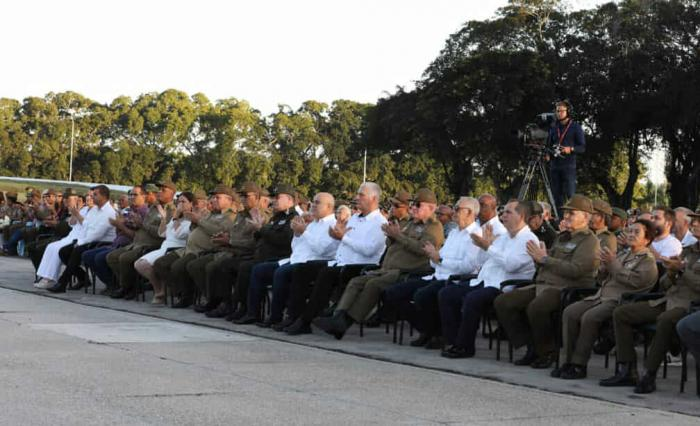
Now, 129 years on, he was commemorated alongside his assistant, Captain Panchito Gómez Toro, who also fell in battle. During a political and military ceremony led by Miguel Díaz-Canel Bermúdez, the First Secretary of the Central Committee of the Communist Party of Cuba (PCC) and President of the Republic, Lieutenant General Antonio Maceo was held high as a symbol of resistance during challenging times.
According to José Ramón Monteagudo Ruiz, a member of the Secretariat of the Central Committee of the PCC and leader of its Agri-Food Department, the Bronze Titan symbolizes the rising path in the difficult fight for independence, as evidenced by the over 800 military actions he led.
Through his actions, he demonstrated that intelligence is the most powerful weapon, and that it is possible to counter the adversary's overwhelming technical superiority with cleverness, agility, and bravery. Furthermore, he showcased his unwavering revolutionary stance during the Baraguá Protest by refusing to accept peace without achieving independence or abolition.
This legacy was also connected to the 36th anniversary of Operation Tribute, which paid homage to the thousands of Cuban combatants who have carried out internationalist missions.
Therefore, Monteagudo Ruiz stated that this date eternally solidifies the connection among all generations of fighters: those who perished in the 19th century for Cuba's independence and those who, in the 20th century, fought "not only in defense of their homeland but also for humanity."
The ceremony at El Cacahual was attended by Political Bureau members, including Roberto Morales Ojeda, Secretary of Organization of the Central Committee; Army Corps Generals Álvaro López Miera and Lázaro Alberto Álvarez Casas, who are the ministers of the Revolutionary Armed Forces (FAR) and the Interior (Minint), respectively; Major General José Amado Ricardo Guerra, Secretary of the Council of Ministers, along with leaders from the Party, Government, mass organizations, and other leaders from the FAR and MININT.


This work was translated and shared via a License CC-BY-NC


Comments