


Che honoured at a Day of the Heroic Guerilla youth gathering in Havana

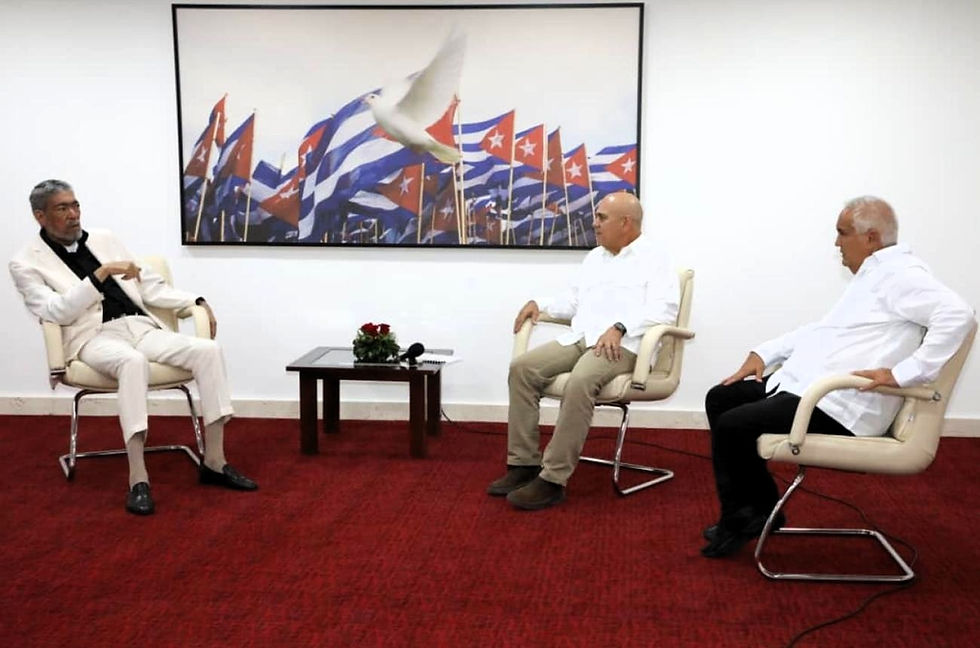
Filled with reflections and revolutionary spirit, a beautiful gathering took place Thursday morning in the Portocarrero Hall of the Palace of the Revolution. It brought together a group of young people and the nation’s leadership to mark October 8, the anniversary of Che’s fall in combat. The event was led by Miguel Díaz-Canel Bermúdez, First Secretary of the Central Committee of the Communist Party of Cuba.

Photos via Estudios Revolución
By Alina Perera Robbio, translated from the Spanish
It was a moving scene – because someone like Che inspires such emotions when remembered – sometimes even bringing a tear to the eye. This Thursday morning (October 8), at the Palace of the Revolution, the country’s leadership met with a group of young people. Being October 8, it was impossible not to recall the legacy of the Heroic Guerrilla, who fell in combat on that very day.
"Che is not dead: Che has multiplied," said the First Secretary of the Central Committee of the Communist Party of Cuba and President of the Republic, Miguel Díaz-Canel Bermúdez, at one point in the exchange. And the idea made a lot of sense: each young person who spoke this Thursday was proof that the new generations know how to rise up to make history; it was evidence that, in the midst of the difficult times that the world and the island are experiencing, a human network of new generations sustains the Guevarian humanism of a Revolution whose hard core of resistance lies precisely in the sensitivity of its children.
Meyvis Estévez Echevarría, First Secretary of the National Committee of the Union of Young Communists (UJC), opened the discussion by reflecting on reconnecting with his political ideals, keeping him present and alive despite the wishes of his opponents. The day’s event was also attended by Roberto Morales Ojeda, member of the Political Bureau and Secretary of Organization of the Central Committee of the Communist Party of Cuba; Deputy Prime Minister Inés María Chapman Waugh; and other leaders.

Doctor of Economic Sciences and president of Ruth Casa Editorial, Carlos Tablada, expressed his honor at being with the young audience. He shared details of his meticulous research on Ernesto Che Guevara’s economic ideas, compiled in a book that, back in the 1980s, significantly and positively influenced Cuban society’s thinking—an influence that continues to challenge readers today.
"Always be rebellious, be very nonconformist," Tablada spoke to the young people present, sharing among other thoughts that Che had a very wide cultural education. Speaking of the Heroic Guerrilla, he remembered his strong ethics – “the day we lose ethics,” he said, “we lose everything.” Regarding studying and thinking independently, the Doctor of Economic Sciences noted that Che might have foreseen, 25 years earlier, the collapse of the Soviet bloc.
Next, Doctor of Historical Sciences Daily Sánchez Lemus shared her perspective, describing October 8 as “a very special day” during which Cuban schools experienced beautiful moments, thanks to the tribute paid by new generations to Che. Speaking about that extraordinary figure, the historian reflected on the responsibility Cubans have to ensure he “continues to be.”
She thought the children should understand why we want them to be like Che. The Heroic Guerrilla, she explained, has a historical responsibility to be present, to be one of those who is continually reborn. She emphasized his remarkable relevance, noting that the tougher the circumstances, the stronger his anti-imperialist passion, the wisdom of his example, and his drive to always improve – that “something else” Raúl had spoken of.
Daily spoke this Thursday about how Che’s image is one of the most maligned, and why his legacy should be taken “beyond the statue.” She stressed the importance of truly understanding who Che was, and highlighted the clear and honest friendship he shared with Fidel, and also with Raúl. She posed a question: “In the hostile context we live in, how would Che act? It’s a question we must ask ourselves and answer in the best way possible.”

GUEVARIAN VOICES
As the voices flowed one after another in the Portocarrero Hall of the Palace of the Revolution, it became clear that new generations are steadily advancing along the challenging path of resistance. The auditorium was just a small glimpse, yet in that space, leadership and rich experience could be felt, born from the Community Youth Network, whose strength in Cuban settings is already undeniable.
Leanet Proenza del Hoyo, main coordinator of the Farma Joven project – a solidarity initiative of the UJC – remembered a Che who always took the lead and said it’s now up to young people to follow his example. She shared how, in their area of work, the new generations are supporting those in need by helping with medicines.
More than a thousand citizens are already connecting through digital networks, especially WhatsApp. “We’ve visited communities, delivering medicines to those without access, to the elderly who need them most. You have to knock on doors. We’ve reached nursing homes, children’s homes, and maternity homes,” said Leanet, adding that they also receive medicines from youth organizations worldwide.

Regarding Farma Joven, President Díaz-Canel Bermúdez described it as “a totally Guevarian attitude,” reflecting a deep sensitivity to the problems of others. “Che was deeply moved by any situation where someone was at a disadvantage. That is why he achieved the highest level of solidarity and proletarian internationalism,” the Head of State remarked.
Recent graduate Dr. Alejandra de la Cruz Moreno, coordinator of the Farma Joven network in Habana del Este, shared her thoughts. She noted that the network has expanded beyond their province. She recounted how around thirty young people contributed their expertise at the pediatric teaching hospital in Central Havana, taking on various tasks, standing guard, and preparing the contingent for anything that might be needed.
Young people from several Community Youth Networks spoke, sharing how they deliver meals to children, create on-screen experiences for mobile cinema, and take courses to train as social workers. They also spoke about how, despite the hatred directed at the island, the Cuban heirs of Che know how to fight without losing their tenderness.
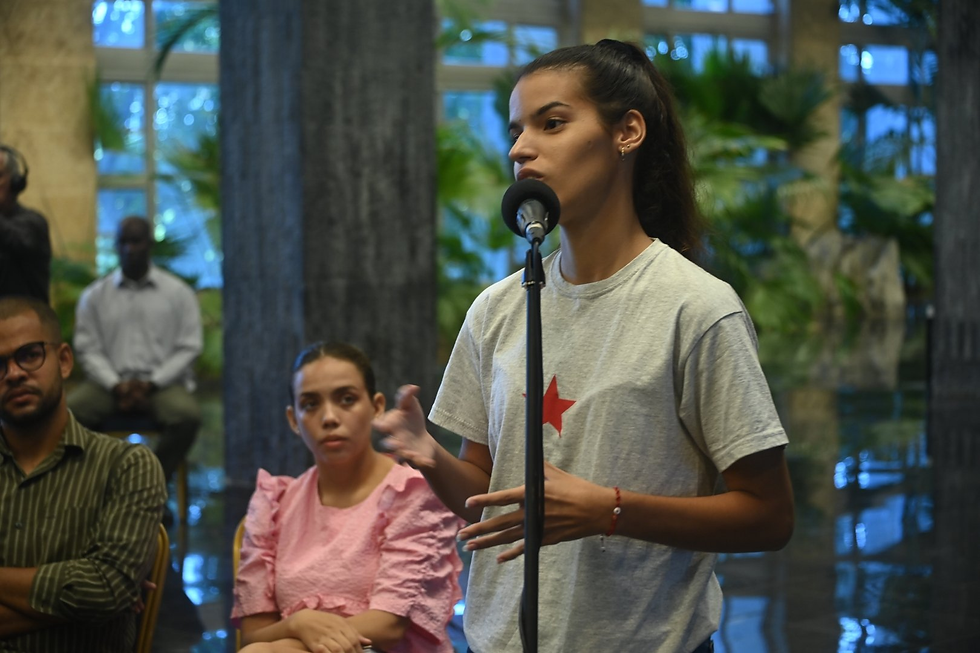
President Díaz-Canel mentioned the idea of the New Man—strongly supported and defended by Che Guevara and widely promoted by Fidel. Addressing the young people, the Head of State said: "You are also new men and women, but we have to continue nurturing that concept. We cannot build a better world if there is not a new Man."
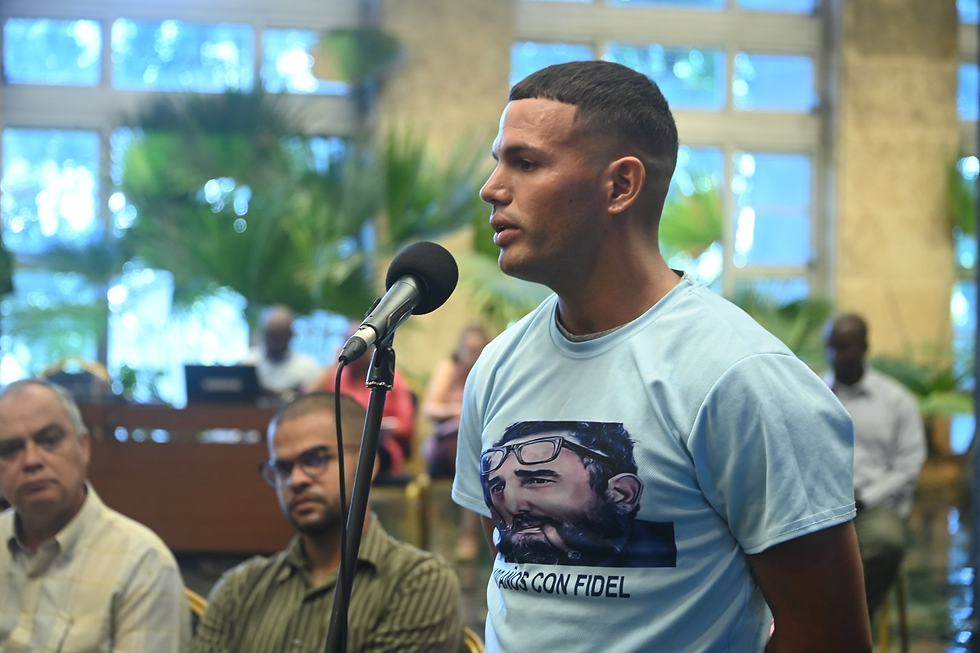
Young people kept raising their voices—future engineers, future athletes, and a university professor who reflected on how Che "forces us to look at ourselves all the time." A Palestinian student, specializing in Orthopedics and a graduate of the Latin American School of Medicine (ELAM), wrapped up the interventions.
His testimony was remarkable, as he hails from the Gaza Strip and shared with the audience what Che's visit to his homeland was like. He described how the Guerrilla could see in the eyes of the Palestinians that they stood tall, never bowed, and did not comprehend the meaning of surrender.
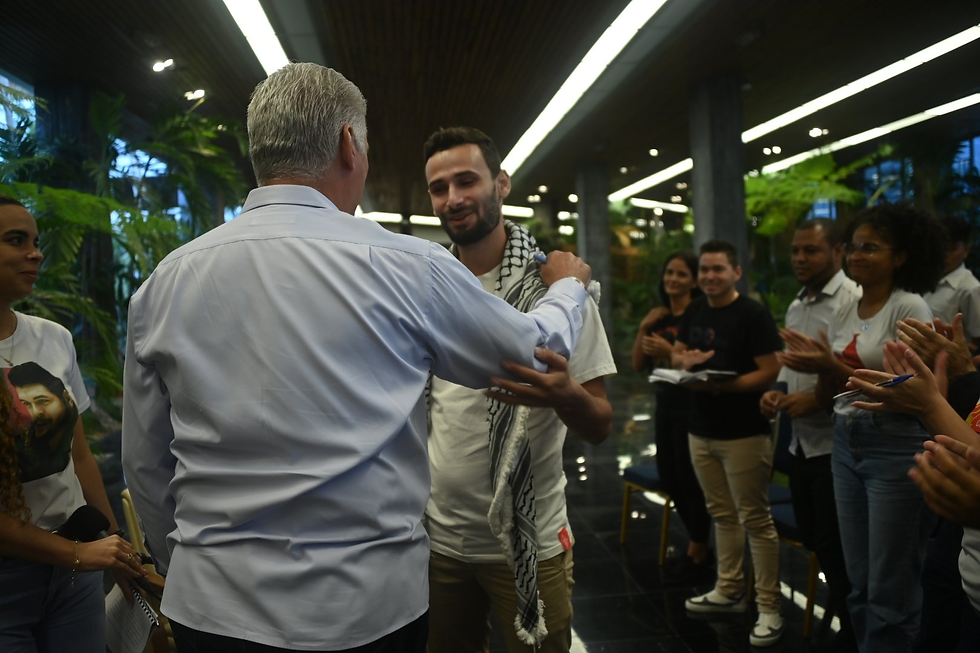
The suffering of his people and that of Cuba inevitably came to light. His words were filled with gratitude for the way the island welcomed him and hundreds of his compatriots. It was touching to hear him speak about how the Palestinian people had donated medicines to Cuban hospitals. The young man asked to embrace the President — and so he did — explaining that in doing so, he felt he was embracing the people of Cuba.
PAYING TRIBUTE TO CHE EVERY DAY
"We could talk to you all day," the president remarked near the end of the exchange. He emphasized that Che "is present every day in the country’s actions and in the leadership of our youth today."
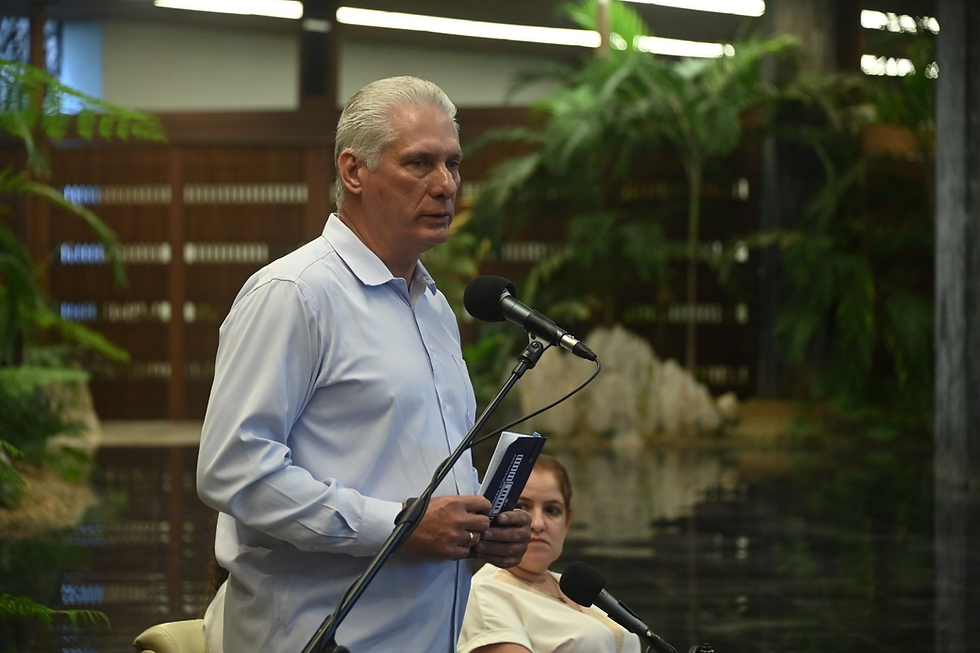
After highlighting the growing prominence of the Community Youth Network, Díaz-Canel said that the tribute to the Heroic Guerrilla is significant "because we are doing it in the year of the centennial of Commander in Chief Fidel Castro Ruz."
The friendship between Che Guevara and Fidel, that "tremendous affinity of principles," was another issue on which the president reflected, who affirmed that both were altruists, both preached by example, both were willing to give their lives, both were serious scholars of Marxism and openly criticized weak defenses and representations of it.
The President evoked historical moments that have remained as testimonies of the "common admiration" that united two exceptional men: Che's farewell letter, where the Heroic Guerrilla makes explicit his resounding admiration for brother Fidel; and that confession of the Commander in Chief, when he said: "I still dream of Che."
(See: A farewell that still resonates: Che's letter to Fidel read for the first time, October 3, 1965)

The Cuban President emphasized that Daily’s call is very important, ensuring that the slogan “we will be like Che” is not just words but something truly heartfelt. “Being like Che is very difficult,” he remarked, adding that simply having the vocation to emulate the Heroic Guerrilla already brings one much closer to his virtues.
"There are people who do not understand how we are resisting," said the Head of State at another point, making clear his belief that the legacy of Che Guevara lives on in the refusal to bow before the empire.
It was inevitable that the President would recall moments from his life where Che held a special significance. Santa Clara, his hometown, was a stage where the Heroic Guerrilla played unforgettable roles. Díaz-Canel remembered events tied to the arrival of the Guerrilla’s remains and those of his Reinforcement Detachment in Cuba’s central province. He spoke of women and men moved by the memorial niches, and recalled, for instance, how Spanish dancer and communist militant Antonio Gades once was overcome with emotion inside the Mausoleum, standing before the tombstone marking the Guerrilla’s resting place.

The president shared more thoughts and feelings about the legendary man, speaking of his revolutionary ethics, his austerity, honesty, and high demands he made to himself. "Che was always willing to do anything without asking for anything in return," said Díaz-Canel Bermúdez, who also emphasized the value that the Guerrilla gave to moral encouragement.
After years of studying, developing ideas, and preparing, the Cuban President has strengthened his belief — and said this on Thursday — that “we need to return to the concept of the new Man.”
For a better world to be possible, he said, "we have to defend it with the values of the new Man." And regarding the ferocious war that the empire is waging on the island, he closed his reflections with a Guevarian spirit: "the present is one of struggle; the future is ours."
This work was translated and shared via a License CC-BY-NC


Comments