


China to strengthen ties and cooperation with Latin America and the Caribbean

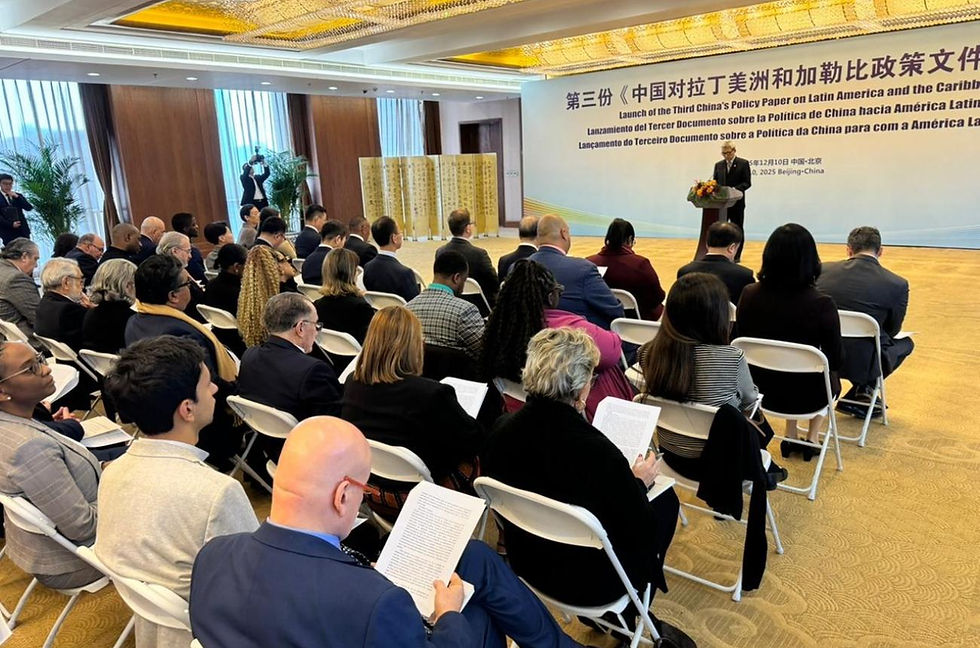
Photo via Alejandro Esquite
By Katherin Hormigó Rubio, translated from the Spanish
In Beijing, the Chinese government introduced the Third China's Policy Paper on Latin America and the Caribbean. This document aims to summarize past experiences and thoroughly outline China's policy towards the region, with the goal of elevating relations and cooperation in various areas between China and LAC to a new level.
The text delivered by Beijing's Assistant Foreign Minister Cai Wei emphasizes China's adoption of an independent foreign policy focused on peace and advocating for universal human values. It also discusses the execution of the Global Development Initiative, the Global Security Initiative, and the Global Civilization Initiative introduced by President Xi Jinping.
Cai Wei pointed out that Cuba and China are jointly building a community of shared future, while at the same time the Chinese government has elevated its relationship with Brazil towards jointly building a community for a fairer world and a more sustainable planet.
He also stressed that there are 24 countries in the region that have joined the great Belt and Road family of joint construction. In this regard, he commented:
"China has become the region's second largest trading partner and the first for Brazil and Peru, as well as being one of the main sources of investment for LAC."
The diplomat stressed that in 2024 the volume of trade between China and LAC exceeded 500 billion dollars for the first time, and that in the first 10 months of this year it approached 450 billion dollars, registering an increase of 3.5%, despite the setbacks.
Cai Wei emphasized that this document outlines the progress of the rapidly developing China-LAC relations, details China's policies and proposals for collaboration in over 40 areas for the upcoming phase, and proactively addresses the region's needs and cooperation interests in sectors such as trade, investment, finance, scientific and technological innovation, and combating climate change.
The assistant minister of the Beijing Foreign Ministry pointed out that "China will always support LAC countries in defending their independence"; in addition, he stressed that "relations between China and LAC are mutually beneficial, do not have any geopolitical calculations, do not target any third party and nor should they be interfered with by them".
In his speech, Cai Wei discussed the Chinese government's dedication to efficiently utilizing the 66 billion yuan (approximately 9.1 billion dollars) credit line, which was announced at the Fourth Ministerial Meeting of the China-CELAC Forum. The focus will be on infrastructure, clean energy, agriculture, digitalization, and artificial intelligence.
He reaffirmed China's commitment to maintaining friendly relations with Latin America and enhancing direct air connections, government scholarships, cultural exchanges, mutual translations of audiovisual works, and cooperation between academic institutions.
The document reiterates China's support for the Proclamation of Latin America and the Caribbean as a Zone of Peace and the Declaration of the Member States of the Agency for the Prohibition of Nuclear Weapons in LAC; it advocates the peaceful settlement of international disputes and pressing issues, and rejects external interference in the internal affairs of LAC countries under any pretext.
It should be noted China's policy document towards Latin America and the Caribbean was presented for the first time in 2008 at which time the Chinese government set the goal of establishing the China-LAC Comprehensive Cooperation Partnership, based on equality, mutual benefit and joint development. In 2014, the leaders of China and LAC held a meeting in Brasilia, where they jointly took this position on China-LAC relations.
In 2016, the Chinese government issued the second Policy Paper on Latin America and the Caribbean . This document declared China's commitment to developing a new framework for China-LAC relations, described as "five in one," and aiming to elevate the China-LAC Partnership of Comprehensive Cooperation to a higher level.
This work was translated and shared via a License CC-BY-NC


Comments